



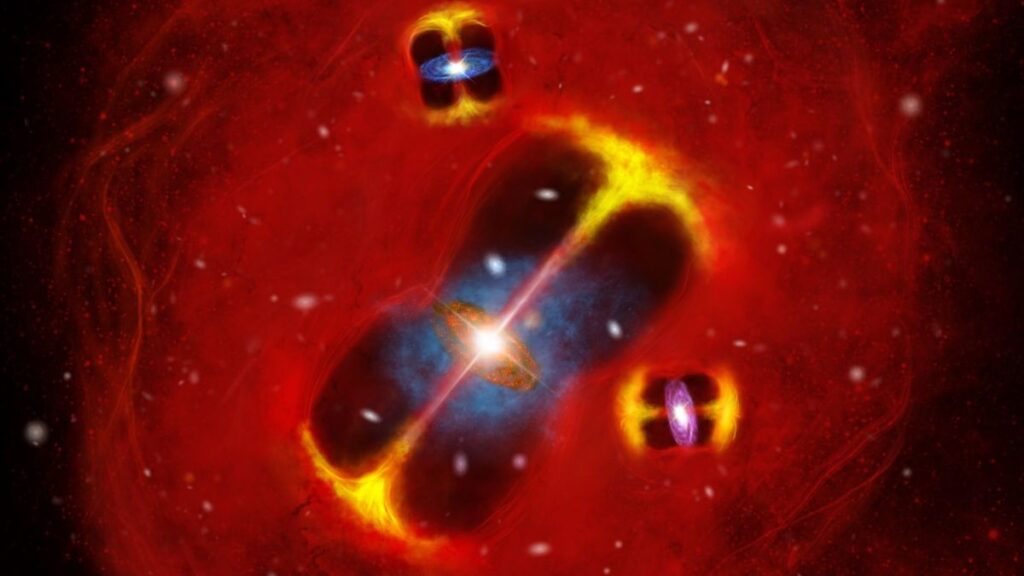
A team of astronomers has identified a galaxy cluster named SPT2349-56, located approximately 1.4 billion years after the Big Bang. This discovery reveals a cosmic anomaly, as the gas within the cluster exhibits temperatures significantly higher than current models predict. The findings challenge existing theories about the evolution of the universe.
The discovery of SPT2349-56 was first made in 2010 using observations from the South Pole Telescope in Antarctica. Early indications suggested the presence of an unusual cluster, which was later confirmed in a 2018 study that identified more than 30 galaxies within it. These galaxies are forming stars at a rate 1,000 times faster than that of the Milky Way, indicating a dynamic and tumultuous environment.
Significant Findings from ALMA Observations
Led by Dazhi Zhou, a doctoral student in astrophysics at the University of British Columbia, the research team employed the ultra-sensitive Atacama Large Millimeter/submillimeter Array (ALMA) to analyze the cosmic microwave background (CMB). Their goal was to detect a distortion known as the Sunyaev-Zeldovich effect, which occurs when electrons in hot gas interact with photons from the CMB.
Zhou noted, “We didn’t expect to see such a hot cluster atmosphere so early in cosmic history. At first, I was skeptical about the signal as it was too strong to be real. But after months of verification, we’ve confirmed this gas is at least five times hotter than predicted.” The results revealed temperatures exceeding 10 million Kelvin, far beyond what gravity alone could generate.
Implications for Cosmic Evolution Theories
The presence of such extreme temperatures suggests that additional energy sources may be at play. Scott Chapman, an astrophysicist at Dalhousie University, explained that powerful jets from at least three supermassive black holes in SPT2349-56 might be injecting energy into the cluster. This finding indicates an unexpected level of activity occurring much earlier than previously thought.
Chapman elaborated on the significance of these findings, stating, “This tells us that something in the early Universe—likely three recently discovered supermassive black holes in the cluster—was already pumping huge amounts of energy into the surroundings and shaping the young cluster.” This challenges the notion that the dynamics observed in today’s galaxy clusters did not apply to the early cosmos.
The research underscores the importance of understanding how intense star formation, active black holes, and overheated atmospheres interact within galaxy clusters. Zhou expressed the desire to further investigate these relationships, stating, “We want to figure out how the intense star formation, the active black holes, and this overheated atmosphere interact, and what it tells us about how present galaxy clusters were built.”
The findings of this study have been published in the journal Nature, marking a significant advancement in our understanding of cosmic evolution and the dynamic processes that have shaped the universe since its inception.