




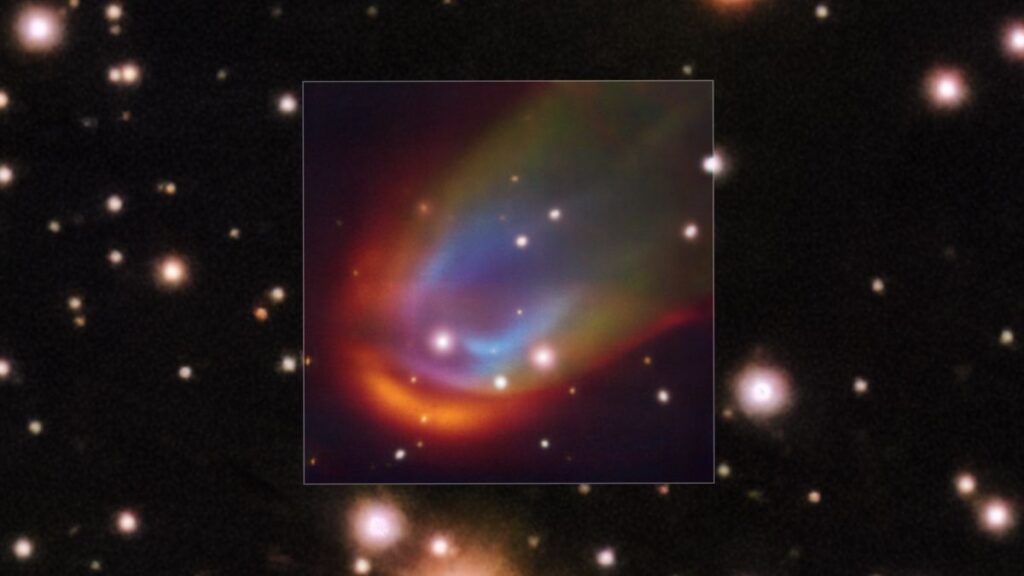
A new discovery involving the white dwarf star RXJ0528+2838, located 731 light-years from Earth, has left astronomers intrigued. This celestial body has revealed a vibrant nebula, described as a powerful and glowing bow shock. What makes this finding remarkable is the absence of a known mechanism to explain the nebula’s formation, which challenges existing theories about white dwarfs.
Astronomer Simone Scaringi from Durham University commented on the unexpected nature of the discovery, saying, “We found something never seen before and, more importantly, entirely unexpected. The surprise that a supposedly quiet, diskless system could drive such a spectacular nebula was one of those rare ‘wow’ moments.”
Understanding White Dwarfs and Their Surroundings
White dwarfs are the remnants of stars like the Sun that have exhausted their nuclear fuel. Once they reach the end of their main-sequence lifespan, their cores collapse into ultra-dense objects that can have a mass up to 1.4 times that of the Sun, despite being roughly the size of Earth. Typically, these stars reside in binary systems, where they can draw material from a companion star, leading to observable phenomena such as thermonuclear eruptions.
In the case of RXJ0528+2838, there is a low-mass companion star, but notably, no surrounding disk of material is present. This absence is significant because, generally, such disks facilitate the creation of bow shocks through collisions between stellar outflows and the interstellar medium. The bow shock surrounding RXJ0528+2838 is unique in its composition, containing wavelengths indicative of hydrogen, oxygen, and nitrogen, suggesting that the outflow has been active for approximately 1,000 years. This timeline contrasts sharply with the explosive outbursts typical of thermonuclear events.
A New Perspective on Stellar Interactions
Researchers speculate that a powerful magnetic field surrounding the white dwarf could be influencing this unusual scenario. Instead of forming a disk, material from the companion star may be channeled along the magnetic field lines directly onto the white dwarf, allowing for continuous outflows without a conventional disk structure.
Krystian Ilkiewicz from the Nicolaus Copernicus Astronomical Center stated, “Our observations reveal a powerful outflow that, according to our current understanding, shouldn’t be there. Our finding shows that even without a disk, these systems can drive powerful outflows, revealing a mechanism we do not yet understand.”
The implications of this discovery are significant. It challenges the established understanding of matter interactions in extreme binary systems, suggesting that there is still much to learn about the processes governing these fascinating celestial objects.
The findings have been published in Nature Astronomy, marking a crucial contribution to the field of astrophysics and expanding our understanding of stellar evolution. As astronomers continue to investigate RXJ0528+2838, they hope to uncover more about the mechanisms at play in this remarkable system.