




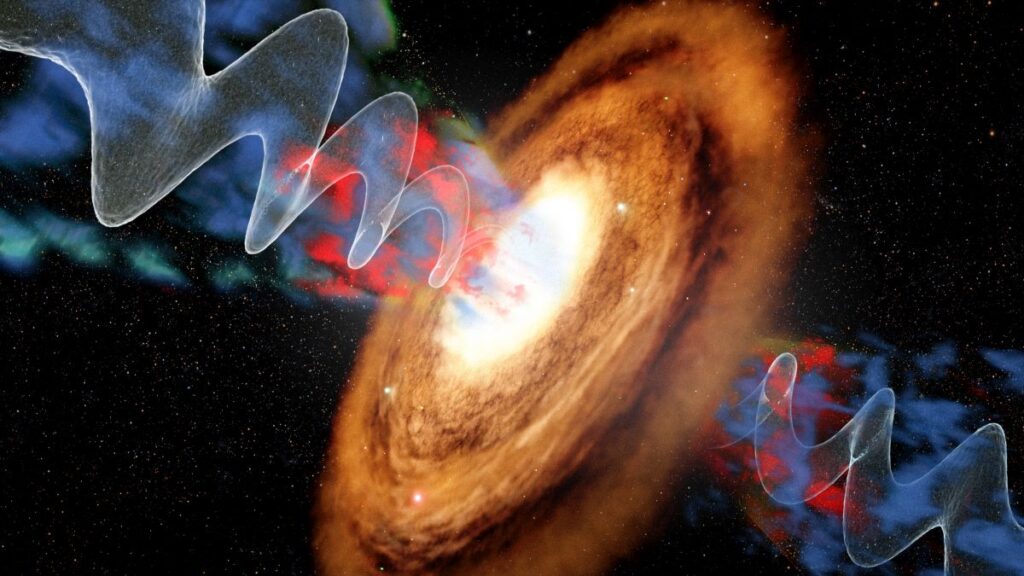
A nearby galaxy, known as VV 340a, has been observed expelling vast jets of superheated gas, shedding light on how black holes can hinder star formation. Located approximately 500 million light-years away, this galaxy’s supermassive black hole is ejecting so much material that it likely impacts the rate at which new stars can form.
Astrophysicist Justin Kader from the University of California, Irvine, noted, “To our knowledge, this is the first time we have seen a kiloparsec, or galactic-scale, precessing radio jet driving a massive coronal gas outflow.” This phenomenon illustrates how black holes can limit the star formation process by heating and expelling star-forming gas.
Understanding the interplay between black holes and galaxy formation is crucial. While supermassive black holes are integral to the formation of galaxies, they can also ‘starve’ them by ejecting excessive radiation. This ejection can lead to a galaxy becoming inactive, although this state is not necessarily permanent.
Black holes can suppress star formation through various mechanisms referred to as “feedback.” These include powerful jets, radiation pressure, and winds generated as black holes consume matter at high rates. Jets are massive structures that erupt from the poles of an actively feeding black hole. As the black hole consumes gas and dust that spirals into an accretion disk, not all material crosses the event horizon.
Astronomers believe that some of this material is funneled away from the inner edges of the disk and propelled along the magnetic field lines of the black hole. When this material reaches the poles, it is launched into space at astonishing speeds, sometimes approaching a significant fraction of the speed of light. Over time, such expulsions can create expansive jets, which can extend millions of light-years into space.
The jets from VV 340a are particularly noteworthy. They stretch about 20,000 light-years in both directions from the black hole and are filled with shock-heated, ionized gas. This gas has temperatures comparable to the Sun’s outer atmosphere, making these jets the largest and most extensive structures of their kind ever discovered. Kader emphasized that, “In other galaxies, this type of highly energized gas is almost always confined to several tens of parsecs from a galaxy’s black hole, and our discovery exceeds what is typically seen by a factor of 30 or more.”
Interestingly, while the jets are large, they are not as powerful as typical astrophysical jets. Nonetheless, VV 340a’s jets are funneling away approximately 19.4 solar masses worth of material from the galaxy each year, a significant amount compared to the Milky Way, which produces about 3.3 solar masses of new stars annually.
The unique shape of VV 340a’s jets may also influence how efficiently star-forming material is evacuated from the galaxy. Unlike straight jets, these jets exhibit a helical shape, resembling a spinning sprinkler. This precession allows the jets to interact with the surrounding gas, dragging it along and heating it to coronal temperatures at distances previously unobserved.
The discovery is particularly striking given that helical precessing jets are typically found in older galaxies, while VV 340a is relatively young and currently merging with another galaxy. The ongoing merger suggests that any impact on its star formation rate may be temporary. Galaxy mergers often trigger periods of heightened star formation, as the collision compresses star-forming material and creates ideal conditions for new stars to emerge.
Astronomer Vivian U from Caltech remarked, “We’re only beginning to understand how common this kind of activity may be. We are excited to continue exploring such never-before-seen phenomena.” U emphasized the potential of advanced observational tools, such as the James Webb Space Telescope (JWST), to uncover more about these dynamic galactic processes.
The findings related to VV 340a have been detailed in the journal Science, contributing to our understanding of the complex relationship between black holes and star formation across the universe. As researchers continue to investigate these phenomena, they hope to gain deeper insights into the evolution of galaxies and the role that black holes play in shaping the cosmos.