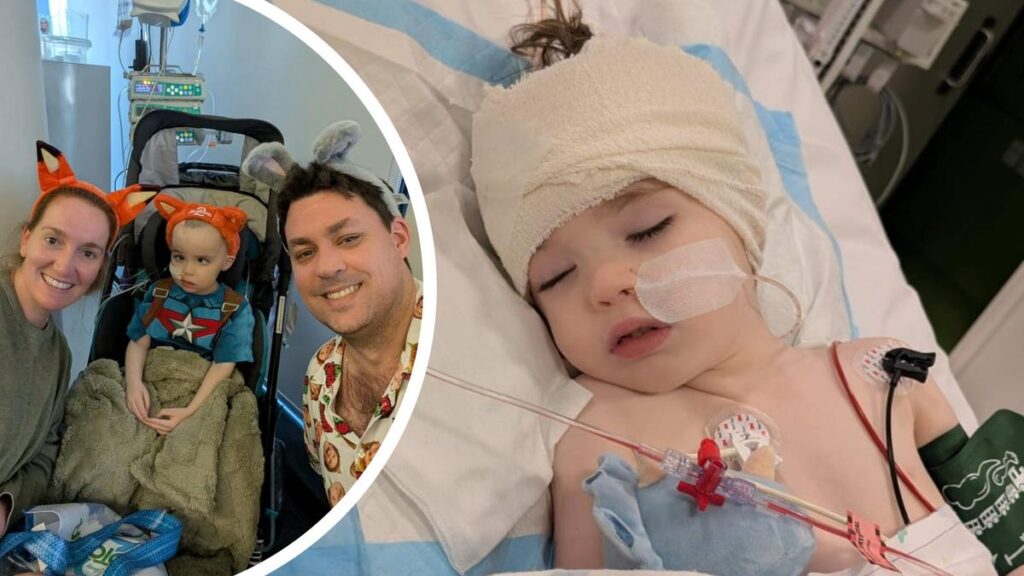
Alex and April Marsh's toddler Connor is fighting metastatic brain cancer. He is pictured right after he had surgery to remove themain mass o his brain.
Two-year-old Connor Marsh is facing a critical battle against metastatic brain cancer, but the treatment he urgently needs is unavailable in Australia. This heartbreaking situation has left his family grappling with the challenges of his diagnosis and the need for specialized care abroad.
In early November 2023, parents Alex and April Marsh received devastating news: their son was diagnosed with a large, aggressive tumor known as medulloblastoma, which has already spread to multiple spots in his spine. Following this diagnosis, doctors informed the family that Connor would require radiotherapy. Unfortunately, the treatment considered the gold standard for children—proton therapy—is not offered in Australia.
Intensive Treatment and Family Struggles
Within a week of the diagnosis, Connor underwent a ten-hour surgery to remove the primary tumor. He is currently receiving care as an inpatient at Perth Children’s Hospital, where he is likely to spend the upcoming Christmas and his third birthday undergoing intensive chemotherapy. The cancer’s rapid progression has led to it covering more than 80 percent of his spine, which is exerting pressure on his spinal cord and causing partial paralysis in his lower body.
“We’re still holding on hope that the paralysis passes and he gets some function back,” Alex Marsh said. “But every day that passes it’s pretty tough.” He added that the family anticipates being in the hospital for several months before they can consider returning home. “At the moment, I’m living at the hospital 24/7, while April is splitting her time between home and the hospital with our one-year-old son, Lachlan, and support from her mum,” he explained. “It’s pretty stressful.”
Need for Proton Therapy Access in Australia
The reality of Connor’s treatment is made more difficult by the need to potentially travel to Florida for proton radiation therapy, which precisely targets cancer tumors while minimizing damage to surrounding healthy tissue. In contrast, traditional radiation poses risks due to high exit doses that can lead to long-term complications, including brain damage.
Australia’s Medical Treatment Overseas Program will cover Connor’s travel to the United States for this treatment, allowing him and one parent to go. However, this support does not extend to the rest of the family, prompting the Marshes to launch a GoFundMe page to help keep their family together during this challenging time. They hope to raise awareness about the need for proton therapy availability in Australia, emphasizing that keeping families together is essential for the emotional well-being of children undergoing treatment.
“It’s a pretty traumatic experience, you have to separate your family and take an immuno-compromised child on a plane for 30-plus hours,” Mr. Marsh noted. “A lot of families are tossing up whether to get the gold standard for their child or to keep the family together during this time.”
Despite the strengths of Australia’s medical system, the Marsh family believes there is an urgent need for advanced treatment options like proton therapy to be accessible within the country. “Children need their families together for this, and the parents need to be together as well,” Alex Marsh stated, highlighting the emotional toll that separation can take during such a critical time.
The Marsh family’s fight underscores a broader issue regarding access to innovative cancer treatments and the profound need for supportive care systems for families with young children facing life-threatening illnesses. As they navigate this journey, they continue to advocate for improvements in the healthcare landscape to help others in similar situations.