




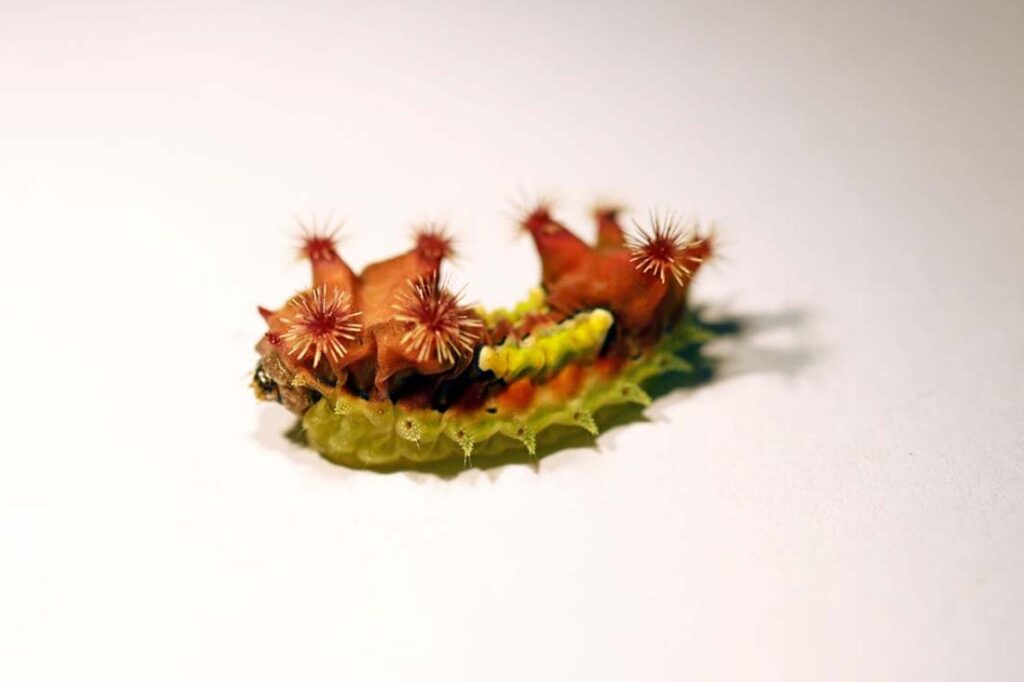
Scientists have successfully decoded the DNA of the highly venomous caterpillar known as Doratifera vulnerans, or the Mottled Cup Moth. This creature is commonly found in Queensland’s south-east and is particularly prevalent in Toohey Forest Park on Brisbane’s southside. The research, led by Dr. Andrew Walker from the University of Queensland’s Institute for Molecular Bioscience, reveals vital information about the caterpillar’s venom, which may have potential medical applications.
Dr. Walker has been studying this striking caterpillar, roughly the size of a 20-cent coin, since 2017. He describes it as a “pocket rocket” due to its potent venom, which contains toxins with a molecular structure similar to those found in spiders, wasps, bees, and ants. Some of these toxins could be instrumental in developing new drug treatments.
The caterpillar’s venom is delivered through tiny needle-like spines and comprises 151 different protein-based toxins, some of which possess the ability to kill bacteria and parasites. Dr. Walker notes that their latest findings offer a fascinating glimpse into how the caterpillar’s immune system has evolved to produce these painful toxins as a defense against predators.
Insights into Venom Evolution
The Institute for Molecular Bioscience houses the world’s largest invertebrate venom library, with a significant portion dedicated to caterpillar venoms. Dr. Walker’s research focuses on understanding how venom has evolved in caterpillars. He highlights that there are over 150,000 species of moths and butterflies, many of which have independently developed venoms with varying compositions.
Some of the venom molecules exhibit insecticidal properties, making them potential candidates for use as pesticides. Others can activate receptors in the human body, indicating their possible applications in treating conditions such as epilepsy, stroke, or even cancer.
According to Dr. Walker, the scientific community’s current understanding of the genomic basis of venom production largely relies on a limited number of species, predominantly snakes. This research marks a significant advancement in the broader knowledge of animal venom and its potential uses.
The findings from this study have been published in the Proceedings of the National Academy of Sciences (PNAS), further underscoring the importance of this research in expanding our understanding of natural toxins and their applications in science and medicine.