



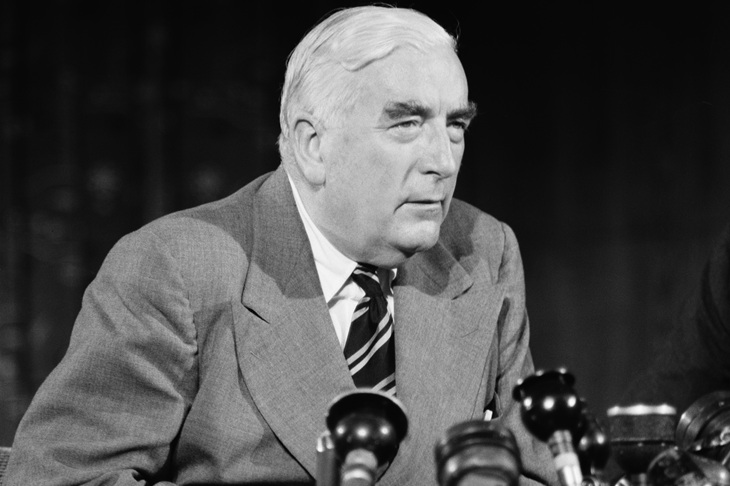
Prime Minister of Australia Robert Menzies during a press conference, London Airport, September 11th 1956. Menzies was leading an international mission to Cairo during the Suez Crisis. (Photo by Bob Haswell/Daily Express/Hulton Archive/Getty Images)
Australia faces a moment of introspection as political conversations seem increasingly disconnected from the experiences of ordinary citizens. Despite being a nation of builders—comprising families, tradespeople, nurses, small business owners, and teachers—public discourse often feels detached from their realities. The constant political noise lacks a moral compass, leaving many Australians feeling as though they no longer dream of a brighter future.
This sentiment echoes the political climate of the 1940s when former Prime Minister Robert Menzies found himself at a similar crossroads. After a turbulent political career, Menzies chose not to retreat but instead began to engage directly with what he termed “the forgotten people.” These individuals, caught between wealth and organized labor, felt invisible to the political landscape. Menzies reached out to the broader population, stepping beyond party factions to restore his credibility by appealing to the core instincts of Australians.
Menzies emphasized foundational values such as work as honor, thrift as virtue, and family as the cornerstone of civilization. These principles were not mere slogans but deeply held convictions. A crucial aspect of his approach was recognizing the fragmentation of the non-Labor political landscape, which had become scattered across minor parties and civic groups. Rather than seeking domination, Menzies focused on unification, convening open conferences that brought these disparate elements together into a cohesive political force.
The formation of the Liberal Party was a deliberate effort to create a broad-based political home, characterized by tolerance for disagreement and unity around fundamental values. Its success, marked by 23 years in government, was no accident.
Today, Australia finds itself in a similar need for leadership marked by a serious sense of purpose. The current pressures are evident, with rapid population growth clashing with housing shortages and strained infrastructure. Public confidence in immigration policy is waning—not due to hostility towards newcomers, but rather an expectation for order, planning, and cohesion. This situation is compounded by the alarming resurgence of antisemitism, which has unsettled a nation that believed such hatred was a thing of the past.
A sense of drift pervades the political landscape, as governments seem more focused on managing headlines than providing clear direction. This does not reflect mere fringe anxieties, but rather a significant issue: a loss of moral authority in national leadership.
Australians do not demand perfection but seek competent leadership grounded in conviction. They desire immigration policies that are both generous and orderly, a confident multiculturalism that defends shared civic standards, and leaders who unequivocally denounce antisemitism and sectarian hatred as unacceptable in a decent society.
Renewal must also be practical, aiming to restore opportunities across the country. This includes housing reforms that make home ownership attainable, prioritizing apprenticeships and vocational pathways as essential for nation-building, and creating tax and regulatory systems that reward effort over speculation. Social cohesion should be treated as vital infrastructure—something to safeguard rather than take for granted.
Historical patterns indicate that when a political tradition splinters, renewal often arises not from louder factions but from leaders who unify shared convictions under a common banner. Menzies understood that unity does not equate to conformity; it involves agreement on fundamental principles.
Australia does not require a savior but rather a leader with the conviction to serve. A leader willing to restore confidence through honesty, to set standards, and to trust Australians to meet them. When such a voice emerges, the nation will recognize it instinctively, resonating as common sense articulated with moral authority.