



Australians increasingly view artificial intelligence as a significant threat to the nation’s security and stability, according to a recent survey conducted by the Australian National University National Security College. The research, which included responses from over 12,000 individuals across two rounds of surveys in November 2024 and July 2025, revealed a shift in public concern towards technology-related issues, alongside traditional security threats.
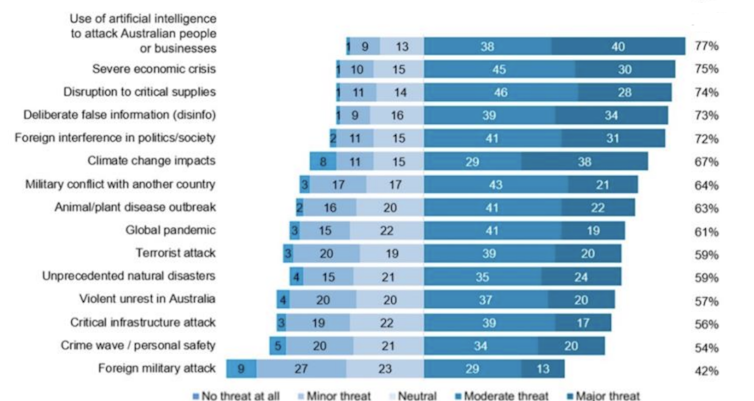
In July 2025, respondents rated the use of artificial intelligence to attack people and businesses as the most serious threat, with 77% expressing concern. This was closely followed by fears of a severe economic crisis at 75% and disruptions to critical supplies due to overseas crises at 74%. The deliberate spread of misinformation to mislead the public ranked fourth at 73%, while foreign interference in Australia’s political and social systems came in fifth at 72%.
Shifting Priorities in National Security
Climate change emerged as the sixth most pressing concern, with 67% of participants acknowledging it as a threat. Notably, 38% rated climate change as a “major” threat, following closely behind AI-related concerns, which garnered 40% in that category. The prospect of Australia being involved in military conflict ranked seventh at 64%.
The survey indicates a growing anxiety regarding national security, as half of the respondents in July agreed with the statement, “I am worried about Australia’s national security,” reflecting an 8% increase since November 2024. The rising threat perceptions encompassed all 15 potential threats evaluated in the surveys.
The findings also highlight the national priorities Australians wish to focus on over the next five years. The foremost priority is the establishment of safe and peaceful communities, chosen by 35% of respondents. Including second preferences, this figure rises to 64%. This priority resonates across various demographics, including age, gender, cultural background, education, income, and location.
The other national priorities identified were:
– Increasing Australia’s economic prosperity (26%)
– Upholding democratic rights and freedoms (23%)
– Strengthening national security (15%)
Community Engagement and Insights
The research included over 300 interviews across Australia, revealing that national security concerns are often framed as essential for the peaceful continuity of everyday life. Professor Rory Medcalf, head of the National Security College, commented on the findings, stating, “Australians know what they want to protect, especially in terms of peace, safety, community, democracy, and prosperity. At the same time, they recognize that a complex set of rapidly emerging threats can put these cherished priorities at risk.”
The full results of this extensive research are expected to be released early next year, providing further insights into the evolving perceptions of security threats in Australia. The Australian National University National Security College, a collaborative initiative of the federal government and the university, conducted these community consultations as part of its independent research efforts.
The findings underscore the need for a nuanced understanding of the evolving landscape of threats, particularly as Australians grapple with new technologies and their implications for society.