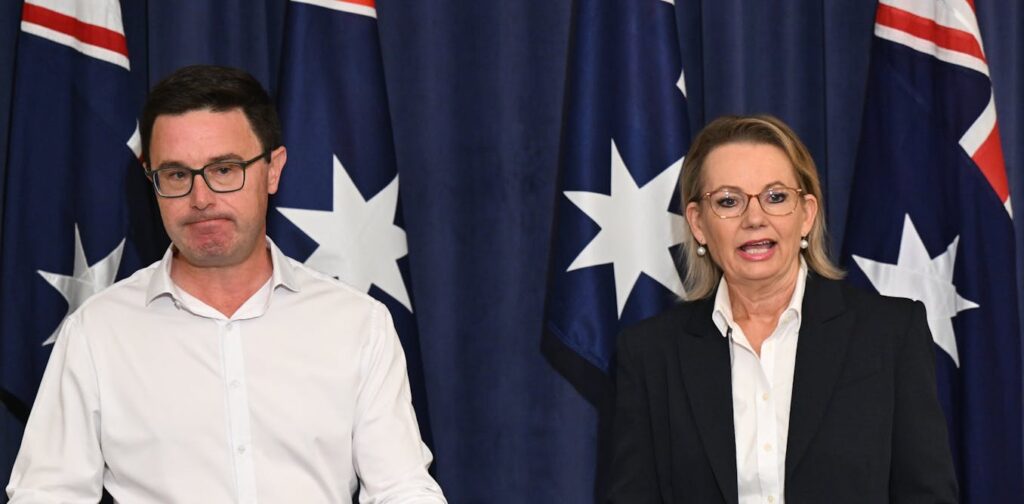
Sussan Ley and David Littleproud announced a last-minute reconciliation of the federal Coalition on Sunday, aiming to stave off an imminent leadership challenge from Angus Taylor. Despite this effort, uncertainty looms over Ley’s position as the latest Newspoll reveals a significant plunge in support for the Coalition, raising questions about its future cohesion.
The Newspoll results, released on Sunday evening, indicate that the Coalition’s primary vote has dropped to a mere 18%, with the Liberal Party standing at 15% and the Nationals at 3%. Ley’s net satisfaction rating has also deteriorated sharply, now sitting at -39%, a decline of 11 points since January. Meanwhile, the Labor Party has seen its primary vote rise to 33%, one point higher than the last survey, suggesting a potential increase in its majority if elections were held promptly. Anthony Albanese, the leader of the Labor Party, holds a substantial 19-point lead over Ley as the preferred prime minister.
Prior to the poll’s release, Liberal sources indicated that the results would heavily influence whether Taylor would initiate a leadership challenge this week. Ley’s recent compromise with the Nationals appears to have mitigated one of Taylor’s earlier arguments for a challenge: her failure to reunite the Coalition. However, analysts speculate that if Taylor delays action this week, he risks losing momentum.
The balance of power within the Liberal party room between Ley and Taylor is reportedly very close, with several members still undecided. Ley and Littleproud’s agreement followed intense negotiations aimed at mending a rift that lasted over two weeks, during which Ley threatened to establish an all-Liberal frontbench if the Coalition did not reconcile before parliament’s resumption on Monday.
During a press conference in Canberra, Ley showcased a strong performance, although the lack of rapport between her and Littleproud was palpable. Observers noted that Littleproud avoided eye contact with Ley while she spoke, highlighting their strained relationship. Reports suggest that tensions escalated to the point where Littleproud confronted Ley during discussions over the split.
A pivotal component of the new Coalition agreement stipulates that all shadow ministers must sign a pact to adhere to shadow cabinet solidarity, aiming to prevent further discord within the Coalition. A “decisions register” will be established to ensure that neither the Liberal Party nor the National Party can overturn shadow cabinet decisions. This is crucial for maintaining unity, although critics within the Nationals have expressed concern that it undermines the party’s autonomy.
The Coalition’s crisis began when three Nationals frontbenchers defied a party decision and voted against the government’s anti-hate legislation. Ley responded by dismissing them for breaching shadow cabinet solidarity, initially demanding a six-month suspension from the frontbench for those members. The latest agreement allows for a return to their previous roles on March 1, 2024, after a six-week period where all Nationals will have served outside shadow ministerial portfolios.
In their joint statement, Ley and Littleproud emphasized the importance of joint representation and accountability during this transitional phase. They also announced that moving forward, both leaders will participate in meetings regarding leadership and economic strategies, reinforcing collaborative decision-making.
As the Coalition prepares to reconvene in parliament, members are expected to present as a united front, contrasting with the previous week’s situation where the Nationals operated independently. Ley’s initiative to form an all-Liberal frontbench had potential appeal for some party members seeking promotion, but a broader consensus suggests that unifying the Coalition is the paramount objective.
Ley asserted during the press conference, “The overwhelming majority of my party room knows that the Coalition is stronger together.” Littleproud echoed this sentiment, insisting that the dispute over the hate legislation was not merely a personal issue but a matter of principle, reflecting the need for both parties to collaborate effectively.
In a landscape marked by fluctuating public support and complex internal dynamics, the future of the Coalition hangs in balance, with immediate challenges ahead for its leadership.