
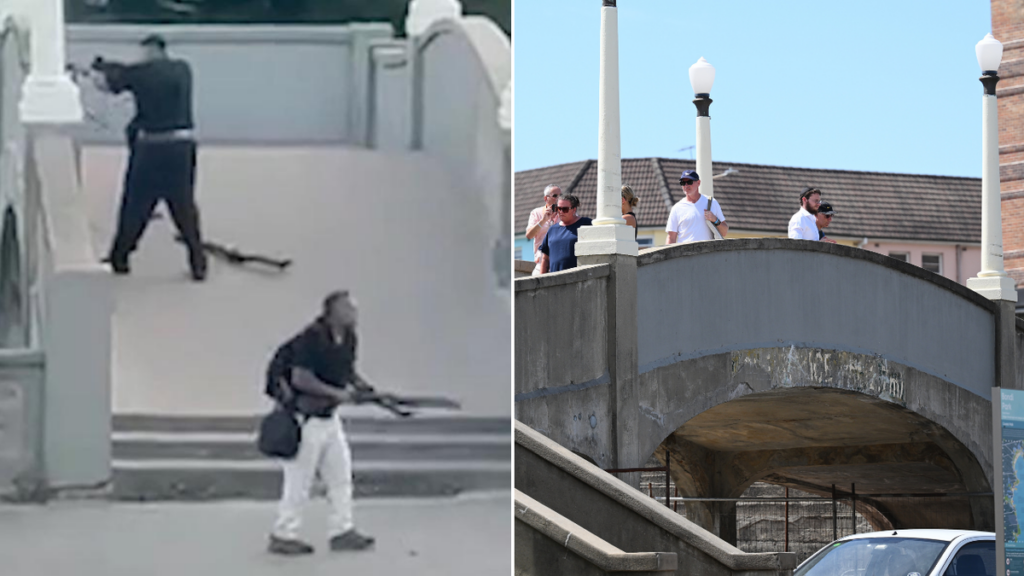
A community gathering in Bondi Beach has sparked a heated debate over the future of a heritage-listed footbridge linked to Australia’s deadliest terror attack. Local residents and members of the Jewish community convened on October 26, 2023, for an extraordinary meeting organized by the Waverley Council to discuss whether the footbridge should remain or be demolished.
Waverley Council Mayor William Nemesh facilitated the meeting, inviting over a dozen speakers to share their perspectives on the footbridge, which has become a symbol of tragedy since footage emerged showing the attackers using it for cover. Calls for demolition have gained traction, notably from New South Wales Premier Chris Minns, who highlighted the need for decisive action.
The council referenced a structural report set for 2024, which suggested that the bridges either be demolished or restored “within a few years.” This recommendation has drawn mixed reactions from the community.
Local Voices: Heritage vs. Healing
Several speakers expressed concerns that demolishing the bridge would be an impulsive response to the tragedy, characterizing it as succumbing to the “ghoulishness” of the shooters. Bondi local Alison Bevege voiced her frustration, stating, “Those bridges are part of our heritage. Please don’t punish us for what other people did; it’s not the bridge’s fault.”
Others, including community members Adrienne Kern and Carolyn Saul, proposed an alternative vision. They suggested that the bridge could be transformed into a permanent memorial, advocating for a restoration project incorporating community-led elements, such as thousands of white pebbles to replace floral tributes that arose after the attack.
Nicolette Boaz, representing the Friends of Bondi Pavilion, urged the council to engage in ongoing consultations with the community. “These bridges are part of our cherished public spaces,” she emphasized, suggesting that the council should consider creating a place of “healing and pacifism” in a more secluded area of Bondi, similar to memorials for the Bali bombing and the Port Arthur massacre.
Memorial Proposals and Community Sentiment
The discussion also extended to the direction of a permanent memorial to honor the victims of the attack. Rabbi Shua Solomon articulated a vision for the memorial to reflect “Jewish pride and Jewish life,” recommending a menorah as a symbol of resilience. This sentiment resonated with several attendees, who echoed the idea of using a menorah from the Jewish holiday of Hanukkah as part of the tribute.
Additionally, spaces alongside the iconic Bondi Beach Sea Wall have been earmarked for murals, including one dedicated to Chloe Byron, a local victim of the Bali bombing.
During the meeting, attendees also had the opportunity to remember loved ones affected by the attack. Arsen Ostrovsky, who survived a bullet wound to the head, poignantly shared his experience, describing himself as a “survivor of a day that will be seared into our memories.” He characterized his survival as a “miracle” and urged the council to consider the emotional weight of their decision.
Despite the passionate community response, the Waverley Council announced that it would take additional time to consult with residents and the state government before reaching a decision. Deputy Mayor Keri Spooner emphasized the importance of careful deliberation, stating, “The only thing we should be focusing on is the tragedy. It will take time, deliberation, and consultation.”
With the future of the footbridge hanging in the balance, the community remains divided but united in their desire to honor the memories of those lost while preserving their cultural heritage. The council’s forthcoming decision will undoubtedly reflect the complex interplay of grief, heritage, and the community’s collective voice.