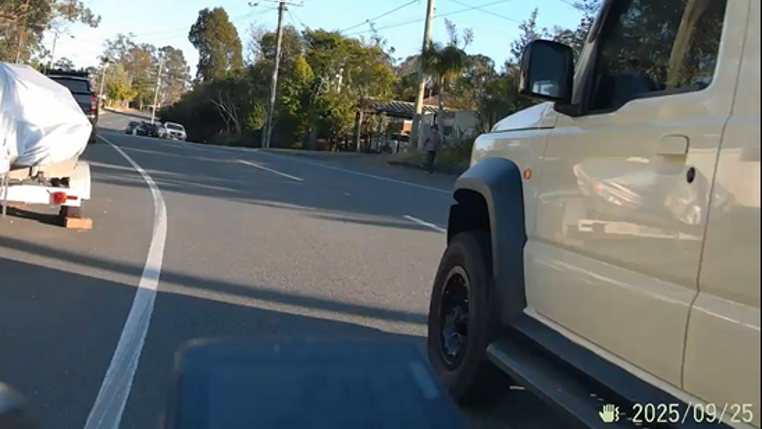
Cyclists in Queensland are voicing concerns over the lack of enforcement of minimum passing distance laws, despite video evidence of violations. On February 12, 2026, an alarming account was shared by cyclist Michael Bradbrook, who experienced a near-miss while riding on Chapel Hill Road. The incident highlights ongoing issues with driver compliance and enforcement of laws designed to protect cyclists.
Bradbrook was cycling to work just before 07:00 when a four-wheel drive sped past him, missing his right arm by mere centimeters. “I knew this one was fast and close when I felt the wind on my left elbow and shoulder,” he recounted. He noted that riding predictably is crucial for his safety, especially in areas where drivers often ignore the one-metre minimum passing distance rule.
Originally established in Queensland in 2016 after a trial prompted by a series of cyclist fatalities, including the tragic death of violinist Richard Pollett, the law mandates a minimum distance of one metre when passing cyclists in speed zones of 60 km/h or less, and 1.5 metres in higher speed zones. Yet, data reveals that enforcement remains woefully inadequate. Last financial year, only 36 fines related to cyclist violations were issued, with just two for e-scooter infractions.
Despite the low number of penalties, a survey conducted by Amy’s Foundation indicated that nearly every cyclist in Queensland has encountered a close pass from a vehicle. Of those who reported such incidents, approximately 78 percent provided video evidence, but only about one in three cases resulted in fines for drivers.
Katherine Bates, a representative from Amy’s Foundation, emphasized the importance of enforceable laws. “Driver education matters too, particularly for newly licensed drivers who need to understand the law before they get behind the wheel,” she stated. Bates pointed out that while drivers may know the rules, the critical element of consequence for violations is missing.
In an effort to improve compliance, Bates proposed that Queensland adopt a model similar to that of the Australian Capital Territory (ACT), where cyclists can submit video evidence of close passes, allowing police to issue fines and demerit points efficiently. “An officer still reviews the evidence, but the process is efficient, and it doesn’t require police to be on every road at the time of the incident,” she explained.
The issue of driver behavior is echoed by Matthew Burke, chief executive of Bicycle Queensland, who noted that members have reported increasing disregard for the minimum passing distance laws. “Queensland riders told us they wanted a ‘refresher’ advertising campaign to reinforce these messages and knowledge of the laws,” he said.
A spokesperson for Queensland Police affirmed their commitment to community safety and emphasized the importance of awareness regarding passing distances. “We ask drivers to be on the lookout for cyclists and PMD [personal mobility devices], be patient and ensure to allow the minimum passing distance,” the spokesperson said.
Despite these efforts, a CARRS-Q evaluation of the trial period revealed challenges in enforcement. Many drivers expressed concerns about their ability to comply with the law on narrow or winding roads or when faced with oncoming traffic. Research from Western Australia indicated that while laws and campaigns led to slight improvements in driver behavior, the establishment of protected infrastructure provided greater safety for cyclists.
To further raise awareness, a spokesperson from Queensland Transport and Main Roads mentioned that the government’s StreetSmarts program promotes bicycle and e-mobility safety through a year-round social media initiative that reaches over 1.5 million road users annually. “TMR will continue to promote this content in 2026 to further raise awareness of the minimum passing distance rule,” they assured.
As cycling continues to grow in popularity, the call for enhanced enforcement and driver education becomes increasingly urgent. The safety of cyclists on Queensland roads depends on a collective effort to respect and uphold the laws that protect them.