


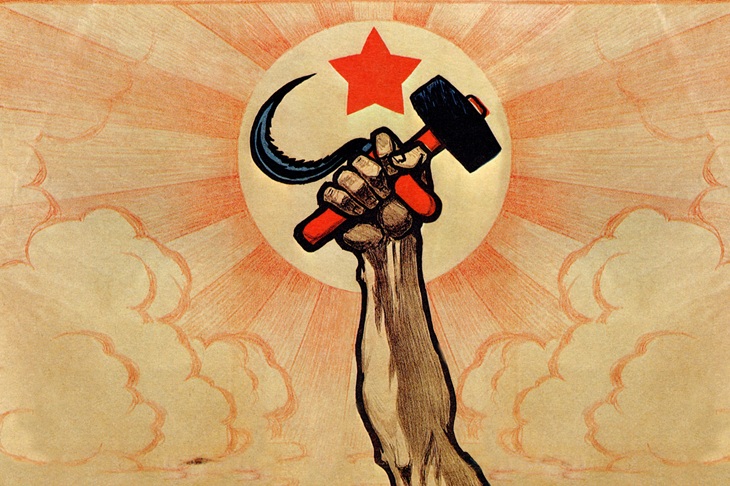
Symbols of communism: the hand wielding the hammer and sickle, in the background the rising sun and the red star ***Long live the fifth anniversary of the Great Proletarian Revolution!***. Color lithograph. Digital optimization from detail of a Ivan Simakov 1922 poster. Italy, Milan 2016. (Photo by Fototeca Gilardi/Getty Images)
As the world enters 2024, a critical examination of the psychological and societal underpinnings of totalitarianism emerges. In this analysis, the argument is made that the stability of authoritarian regimes often relies on a populace disconnected from meaning and purpose.
Understanding the Dynamics of Control
Totalitarian regimes, whether overt or subtle, thrive on the idea of a population that lacks a clear sense of purpose. Citizens who struggle to find meaning in their lives become easier to govern. They can be frightened, pacified, and manipulated into outsourcing the very task of living to the state. This dynamic creates a dangerous cycle where individuals, devoid of internal moral frameworks, look outward for guidance, often to the very institutions that seek to control them.
The real threat to such regimes is not active dissent but rather the presence of dignity and self-reliance within the individual. A society made up of individuals who accept the inherent challenges of existence becomes resistant to tyranny. They do not instinctively turn to the state for solutions during difficult times, having already come to terms with the complexities of life.
The Role of Meaning and Responsibility
The notion that meaning is essential in counteracting suffering is paramount. The Western tradition has long emphasized the importance of individual redemption over collective identity. Individuals are the ones who experience suffering, not groups. Hence, any political system that prioritizes collective welfare at the expense of individual sovereignty is on a precarious path.
To combat totalitarian impulses, it is crucial for individuals to embrace personal responsibility. Those who take charge of their lives—be it in family, work, or personal commitments—do not require oversight. They govern themselves, which in turn diminishes the state’s justification for encroaching on their autonomy. The relationship between responsibility and freedom is clear: when individuals relinquish their agency, they invite supervision and control.
Moreover, a society that dismisses the sacred aspects of life does not eliminate the human need for worship; it merely shifts focus to material outcomes. When the state assumes the role of the highest authority, it risks becoming a capricious power, enforcing its will without regard for individual dignity.
As the New Year unfolds, the choice remains for individuals to live meaningfully. Those who opt for responsibility over resentment, truth over comfort, will find a path towards genuine freedom. This freedom does not equate to the absence of suffering but rather to the liberation from the desperation that can render suffering exploitable.
In essence, the power of totalitarianism diminishes when individuals actively engage with their reality, accepting life’s burdens rather than fleeing from them. The hope for a more liberated society lies in the hands of those willing to confront life’s challenges head-on.
With the arrival of 2024, the opportunity for renewal presents itself. If enough individuals choose to shoulder the complexities of life with dignity, they can foster a resilient society that stands in opposition to the allure of totalitarian control. As we step into the New Year, the call to action is clear: embrace responsibility, seek meaning, and reclaim personal agency.