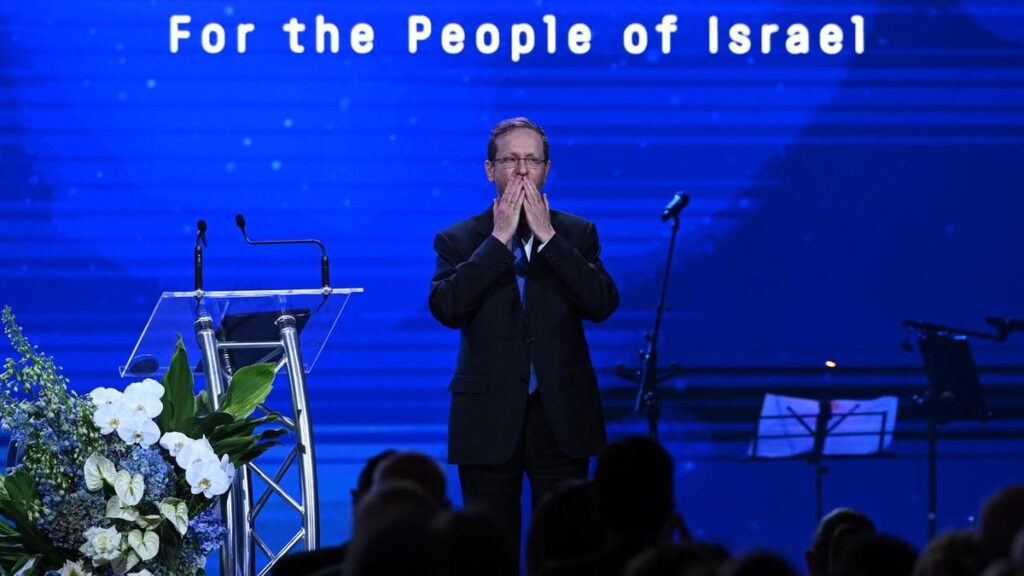
Israeli President Isaac Herzog concluded a four-day visit to Australia that has ignited significant controversy and protests across the nation. While both Herzog and Australian Prime Minister Anthony Albanese hailed the visit as a chance to strengthen bilateral ties, the atmosphere was largely marked by widespread protests and calls for accountability regarding allegations of war crimes.
The visit, initiated in the wake of the Bondi terror attack, was met with mixed reactions from the public. Protests erupted in multiple cities, with demonstrators expressing opposition to Herzog’s presence. Many called for a federal police investigation into the Israeli president, accusing him of complicity in alleged war crimes. This unrest culminated in at least nine arrests and numerous confrontations between police and protestors in Sydney, where tensions escalated during an anti-Herzog rally.
During his time in Sydney, Herzog met with victims of the Bondi attack and attended a ceremony at the Chabad of Bondi, alongside Prime Minister Albanese. His itinerary also included stops in Canberra and Melbourne, where upwards of 10,000 people gathered to voice their dissent. Protesters, invoking international law, demanded Herzog’s arrest, despite his immunity as a visiting head of state.
Notably, a United Nations Special Commission of Inquiry had earlier indicated that comments made by Herzog following the Hamas attacks on October 7, 2023, could be interpreted as incitement to genocide. Although Israel has consistently denied such allegations, Herzog later sought to clarify his remarks, stating they had been taken out of context.
Human rights expert Ben Saul, a United Nations special rapporteur on human rights and counterterrorism, criticized Herzog’s visit, asserting it was politically motivated rather than a genuine attempt to mourn the Bondi victims. “Given the severity of Israel’s violations, this isn’t the time to soft pedal,” Saul remarked, calling for Israel to investigate the allegations seriously.
Prime Minister Albanese addressed the complexities of the visit, reiterating Australia’s commitment to a peaceful coexistence between Israelis and Palestinians. He raised concerns about the death of Australian aid worker Zomi Frankcom, who was killed by an Israeli drone strike in April 2024, emphasizing the need for transparency regarding ongoing investigations.
Despite the protests, members of the Jewish community in Australia expressed support for Herzog’s visit. Alex Ryvchin from the Executive Council of Australian Jewry described the meetings as a “tremendous moment” that could aid in mending relations that have deteriorated since the October attacks. He noted that direct engagement between leaders fosters human connection and understanding, which is often lost in public statements.
Herzog concluded his visit with a message of unity, stating, “We came here to be with you, to look you in the eye, to embrace and remember.” He departed Melbourne on Thursday night, citing an empowered sense of purpose in returning to Israel.
As discussions surrounding the Israeli-Palestinian conflict continue, the ramifications of Herzog’s visit and the protests it sparked may influence future diplomatic relations between Australia and Israel. The complexities of these interactions highlight the ongoing challenges in addressing human rights concerns while fostering international partnerships.