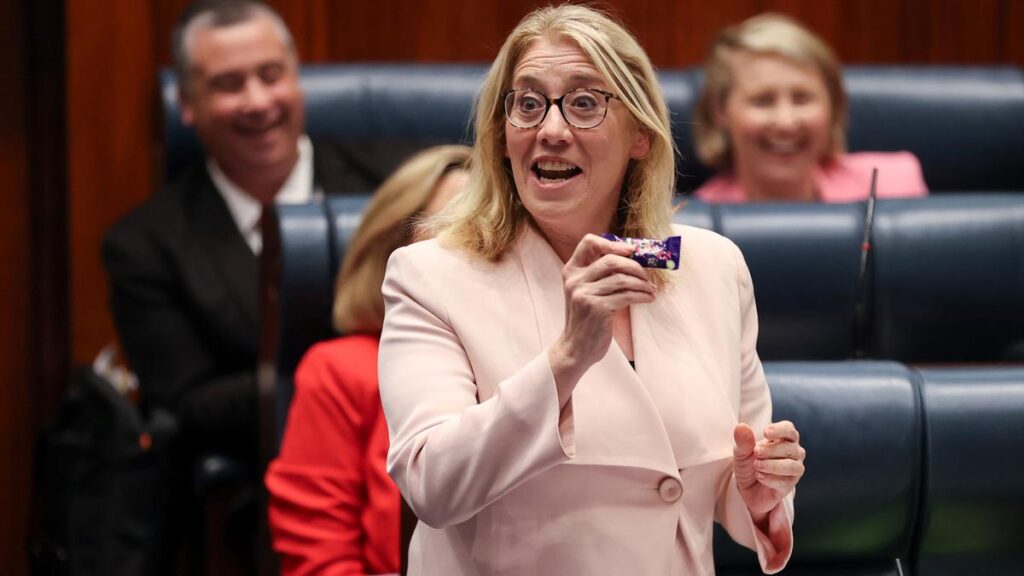
Question time at State Parliament on Thursday. Pictured is Deputy Premier Rita Saffioti holding a chocolate.
The Western Australian Government has faced sharp criticism following its announcement of a significant increase in regional airfare prices. Treasurer Rita Saffioti defended the changes on March 4, 2024, stating that the government has “secured” the regional airfare zone cap with an additional $122 million aimed at maintaining affordable air travel.
However, the reaction from the Opposition has been fierce. Shadow Transport Minister Steve Martin accused the government of presenting a “shameless” broken promise, highlighting that the fine print indicates a staggering 30 percent price hike for flights classified as “high demand.”
Martin stated, “Rita Saffioti needs to explain why regional Western Australians are being asked to pay more for essential transport while she shovels funds into metropolitan pet projects such as the (Burswood) racetrack.”
National Party Leader Shane Love echoed these sentiments, condemning the government for betraying regional communities. “Labor spent the election campaign claiming The Nationals would scrap the airfare zone cap, yet they are the ones who have broken their promise to regional WA by hiking fares,” he remarked. “Labor has finally confirmed the scheme will continue, but only by slugging regional families with higher fares at a time they can least afford it.”
In response to the backlash, Saffioti asserted that the adjustments to the airfare cap are essential for the scheme’s longevity and sustainability. She emphasized that the new pricing is still significantly lower than what regional travelers would face without the cap. “Kununurra is over $1,100 one-way for one person, so we’re still saving families thousands of dollars,” she explained.
Despite the government’s assurances, public reaction has been overwhelmingly negative. Complaints flooded Saffioti’s social media post celebrating the cap, with some expressing frustration over the new one-way fares of $265 for zone one travel and $385 for zone two during peak periods and school holidays. One concerned resident, Talisa Warden, highlighted the impact on families: “So $770 return. How is that helpful for a family of four?”
Another user, Louise Young, expressed disbelief at the price increase, stating, “That’s a massive ouch!” Many residents noted that flights to and from Karratha would likely always be subject to peak fares due to high demand.
Saffioti remained firm in her stance, asserting that the scheme provides good value for money and ensures that families can still access lower fares introduced in 2022. “I believe the majority of people still have access to that $299 fare and $199 fare,” she stated.
As the government grapples with the backlash, the debate over airfares and regional access highlights the ongoing tension between urban and rural needs in Western Australia. The outcome of this situation will likely influence public perception and political dynamics in the region moving forward.