
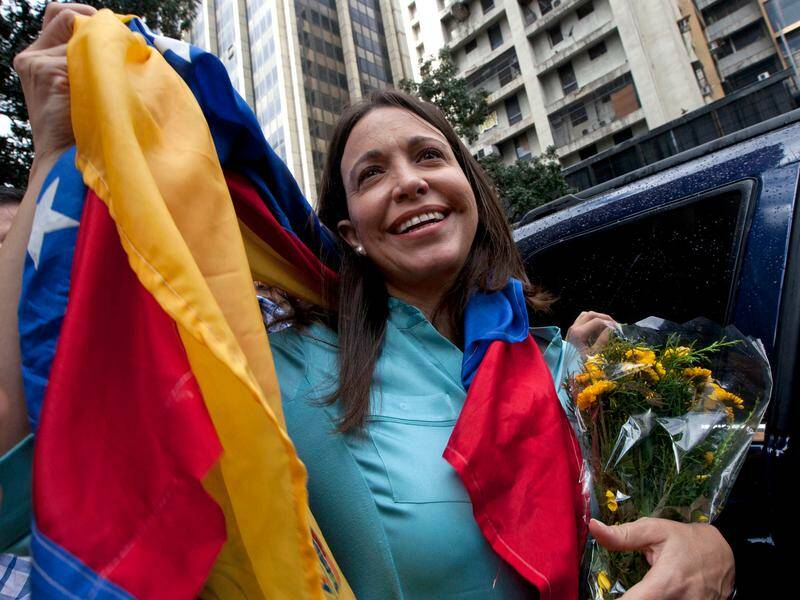
Opposition leader Maria Corina Machado has announced her intent to return to Venezuela following the recent capture of President Nicolas Maduro by U.S. authorities. In an interview with Fox News, Machado expressed her readiness to lead her movement towards a free election, claiming that her party is prepared to secure over 90 percent of the votes under fair conditions.
“I’m planning to go back to Venezuela as soon as possible,” said Machado, who fled the country in disguise last October to accept the Nobel Peace Prize, an award she dedicated to Donald Trump. She stated that the transitional process must continue, emphasizing that her movement had previously won an election in 2024 despite claims of fraud.
Machado highlighted Trump’s role in opposing Maduro, suggesting that his administration must prioritize resolving Venezuela’s issues before any elections can occur. Trump, in a recent interview with NBC, indicated that a timeline for elections within 30 days is unrealistic, stating, “We have to fix the country first. You can’t have an election. There’s no way the people could even vote.”
Following the capture of Maduro, Machado refrained from disclosing her current location or specific plans for her return. She remains a wanted figure in Venezuela, where Maduro’s Socialist Party maintains control. This situation has led to frustration among opposition activists, particularly given that approximately one in five Venezuelans have fled the country due to the ongoing economic crisis.
While Machado seeks to galvanize support, Trump’s administration seems to be leaning towards working with interim President Delcy Rodriguez, a close ally of Maduro. Rodriguez has publicly condemned Maduro’s “kidnapping” while calling for cooperation with the U.S. Machado accused Rodriguez of being corrupt and untrustworthy, labeling her as a “narco-trafficker” aligned with nations like China, Russia, and Iran.
In her praise for Trump, Machado stated that “January 3rd will go down in history as the day justice defeated a tyranny,” and expressed her desire to personally award him the Nobel Prize for his actions. She articulated a vision for Venezuela to become an energy hub for the Americas, promising to restore the rule of law, open markets, and facilitate the return of exiles.
Currently, the U.S. administration faces criticism for its choice to engage with Rodriguez and other officials from Maduro’s regime. Legal experts have questioned the legality of such actions, with many urging adherence to international laws and dialogue.
Maduro, facing multiple narcotics charges in a Manhattan court, maintains his stance as the legitimate president of Venezuela. He and his wife, Cilia Flores, who was also captured, pleaded not guilty to the charges against them. Their next court appearance is scheduled for March 17, 2024. The Maduro administration has long claimed that accusations against them are a guise for foreign interests in Venezuela’s vast oil reserves.
As Caracas grapples with the implications of these political shifts, the situation remains volatile, with Maduro’s administration caught between defiance and the potential for cooperation with U.S. authorities.