




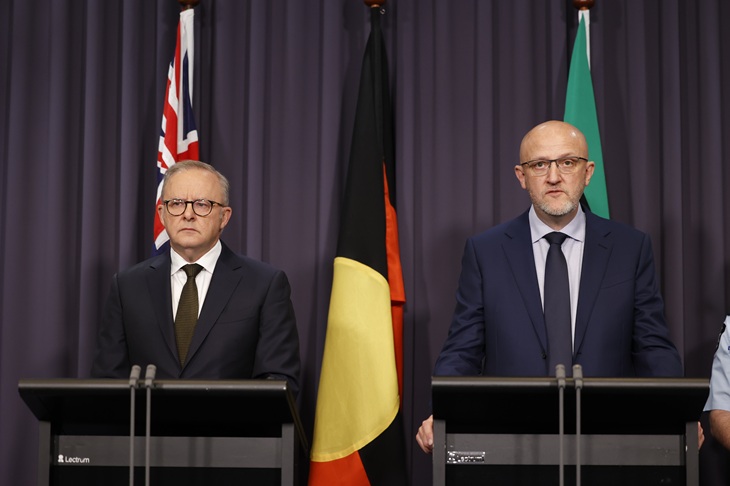
CANBERRA, AUSTRALIA - DECEMBER 14: Director-General of Security of ASIO Mike Burgess (R) and Prime Minister Anthony Albanese (L) speak to the media at Parliament House on December 14, 2025 in Canberra, Australia. Two gunmen dressed in black fired several shots at Sydney's world-famous Bondi Beach, causing at least 10 injuries and three deaths, and setting off mass panic on a Sunday evening. (Photo by Hilary Wardhaugh/Getty Images)
The National Socialist Network, commonly known as the Neo-Nazis, has declared its intention to dissolve before new anti-hate laws take effect in Australia. This announcement raises significant questions about the government’s focus on extremist groups and the implications for national security, particularly in relation to Islamic terrorism.
In a press release, the Neo-Nazi affiliated groups, including White Australia, the European Australian Movement, and the White Australia Party, stated they would disband by 11:59 on January 2026. They expressed concern that the upcoming legislation would lead to their immediate ban, particularly as it allows the government to prohibit organizations that have previously engaged in hate symbols, such as the Nazi salute.
The decision to disband appears strategically timed to evade potential legal repercussions for former members. The message concluded with the rallying cry “Blood and Honour,” a phrase associated with the Nazi youth movement. The dissolution of such a small group, which typically conducted its activities under the cover of darkness in Melbourne, might not evoke widespread sympathy. Still, it highlights a shift in the political landscape regarding hate groups.
Critics argue that the Labor government’s focus on Neo-Nazis serves to divert attention from more pressing issues of radical Islamic extremism. For many years, political leaders have leveraged the existence of Neo-Nazi groups as a talking point, often deflecting questions about Islamic terrorism. The Australian government has faced scrutiny for its handling of radical Islamic groups, particularly in the wake of terror attacks, including the assault at Bondi Beach.
While the Neo-Nazis are retreating, no radical Islamic groups have announced similar intentions to disband. This raises concerns about the effectiveness of the new legislation, which seems to focus on hate speech rather than addressing the direct threat posed by Islamic extremism. There is a growing sentiment that the government’s actions do not adequately protect Australians from the dangers of terrorism.
According to reports, the draft legislation includes provisions that may allow hate speech associated with religious texts to be protected. This clause could shield individuals known for inciting violence from prosecution, as long as their remarks can be linked to a recognized religious discourse. Such a loophole has sparked alarm among various communities, especially given the context of rising antisemitism and violence.
The Australian public is increasingly aware that the roots of antisemitism often intertwine with radical Islamic ideologies. Videos from previous protests, where individuals openly threatened violence against those deemed “infidels,” serve as stark reminders of the challenges the government faces. Many of those involved in these demonstrations remain active within the community, raising concerns about the authorities’ commitment to addressing this issue.
As the government prepares to implement new measures, questions arise about its failure to confront the realities of Islamic extremism directly. Critics are demanding clarity on why Islamic terrorism is not explicitly addressed in the legislation, especially in light of recent attacks that have claimed innocent lives both domestically and internationally.
The apparent reluctance to tackle radical Islamic groups head-on has led to a perception that the government is more comfortable responding to Neo-Nazi activities than addressing the complexities of Islamic extremism. This has left many Australians feeling vulnerable and questioning the efficacy of the government’s approach to national security.
In summary, while the dissolution of the Neo-Nazi groups might seem like a step toward progress in combating hate, the lack of action against radical Islamic extremism highlights a significant gap in Australia’s counter-terrorism strategy. As the legislative landscape changes, the real challenge will be ensuring that all forms of extremism are addressed effectively to protect the community and promote safety for all Australians.