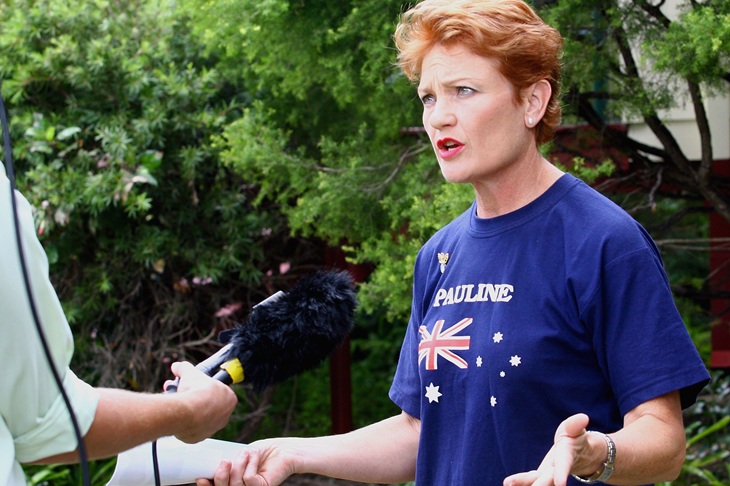
BOONAH, AUSTRALIA - MARCH 21: Independent candidate for Beaudesert Pauline Hanson is interviewed by the media at the Boonah State Primary School during the Queensland State elections on March 21, 2009 in Boonah, Australia. The election will be conducted by the Electoral Commission of Queensland, an independent body answerable to Parliament. (Photo by Bradley Kanaris/Getty Images)
In a bold political statement, Senator Pauline Hanson entered the Australian Senate Chamber on March 5, 2024, wearing a full black burqa. This act followed the rejection of her proposal to ban full-face coverings in Australia. Rather than being dismissed as a mere publicity stunt, this protest served as a stark representation of her views on national security, cultural integration, and Australian identity.
Hanson’s protest has ignited considerable discussion on critical issues regarding Australia’s safety and future direction. With rising concerns over domestic terror incidents, her actions prompted reflection on the role of politicians in addressing security matters. Critics argue that Hanson’s approach trivializes serious issues, yet many supporters assert that she has highlighted a significant topic deserving of attention.
Hanson previously donned the burqa in Parliament in 2017 to draw attention to alleged connections between full-face coverings and terrorism. At that time, she faced no formal punishment. In contrast, her recent protest led to widespread condemnation, culminating in a seven-day suspension, suggesting a shift in political climate and responses to such displays.
After her protest, Hanson asserted that her right to free speech was being curtailed. She emphasized that while there is no formal dress code in the Senate, her actions were deemed inappropriate, questioning the fairness of such a ruling. “There is no dress code on the floor of Parliament, yet I’m not allowed to wear it,” she told reporters, indicating her frustration with the treatment she received.
The burqa, a garment deeply rooted in cultural and religious practices, has become a focal point in discussions on women’s rights and national security. Critics, including Hanson, argue that the burqa symbolizes female oppression, while also raising concerns about anonymity in public spaces, which can hinder security efforts. Christian Faith and Freedom Inc, an organization advocating for persecuted individuals globally, described the burqa as a “mobile prison” that restricts women’s identities and communication.
The legal landscape surrounding a potential nationwide burqa ban in Australia remains complex. The Senate’s refusal to allow Hanson to introduce her bill suggests a lack of institutional support across political parties. Any legislative move would likely face challenges related to constitutional rights, human rights, and religious freedoms.
Internationally, several European nations, including Austria, France, and Belgium, have enacted bans on full-face Islamic veils, citing security and social cohesion as justifications. Despite the small number of women who wear such garments, these countries have engaged in extensive discussions about the implications of such bans. For example, Italy, under Prime Minister Giorgia Meloni, has proposed fines for those who defy a proposed ban.
Hanson’s recent actions have drawn both support and criticism, illustrating the polarized views surrounding the burqa debate in Australia. While some see her as a champion of free speech and Australian values, others criticize her approach as inflammatory. The incident raises broader questions about how Australia navigates issues of national security and cultural integration within a diverse society.
In an era where political communication is often scrutinized, Hanson’s protest underscores the need for open dialogue on contentious issues. As discussions surrounding the burqa continue, the challenge remains: how to integrate deeply religious individuals into a society founded on principles of freedom and democracy. The ongoing debate reflects a fundamental question about national identity and the principles that guide it.