
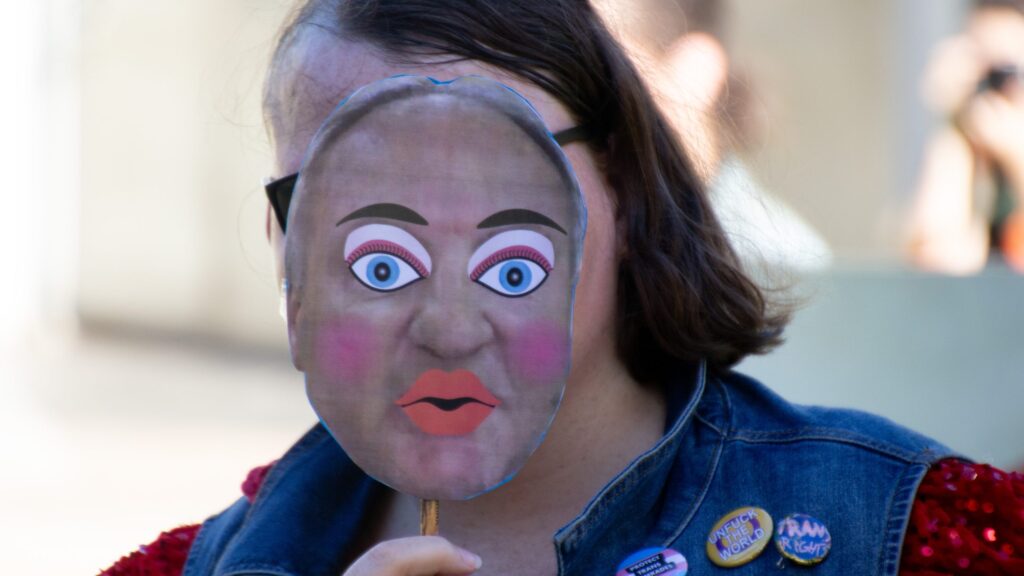
Members of Perth’s LGBTIQA+ communities and their allies gathered at Northbridge Piazza on December 23, 2023, to protest the Northern Territory government’s recent decision to block access to puberty blockers for individuals under the age of eighteen. The Northern Territory’s Country Liberal Party (CLP) government announced this policy shift, stating it would withdraw funding for puberty blockers and gender-affirming hormones for minors. Health Minister Steve Edgington characterized the move as a stance against “dangerous ideologically driven practices” within the healthcare system.
During the protest, approximately 60 attendees displayed masks depicting Edgington’s face, referencing a well-known poster that parodies the stance of Russian leader Vladimir Putin on LGBTIQA+ rights. The WA Police imposed several restrictions on the event, yet the gathering remained peaceful, with no incidents reported. Following speeches from various speakers, the group marched to Yagan Square, where an open-mic segment allowed attendees to share their personal experiences and concerns.
A central theme emerged from both scheduled speakers and audience members: the fear that the erosion of transgender rights could extend to adult medical rights, broader LGBTIQA+ rights, and women’s health rights. The decision to ban puberty blockers follows a similar announcement from the Queensland government, which extended its ban on the treatment until at least 2031. Meanwhile, the United Kingdom has instituted a ban based on the findings of the Cass Review into gender treatments, a report that has faced scrutiny from international experts. New Zealand has also indicated plans to implement a ban, following the UK’s lead, although this decision is currently being challenged in the High Court.
Recent research published in the Journal of Pediatrics highlighted a significant reduction in mental distress among young people who were able to access gender-affirming treatment. At the rally, Maddie, a patient at Western Australia’s Youth Gender Clinic, emphasized the importance of celebrating the resilience of transgender individuals. “I just want to celebrate every trans person in this country, and in my life, who continues to live openly and fight for the life that we want to live,” she stated.
Maddie pointed out recent political victories for transgender rights in Australia, including the removal of the WA Gender Recognition Board and significant updates to similar laws in New South Wales that eliminated the requirement for individuals to undergo surgery to legally change their gender. She noted that the nationwide protests following Queensland’s ban in early 2025 could be interpreted as a rejection of divisive political tactics targeting transgender individuals. “I think it’s worth celebrating, and I think we need to hold on to every little sign that we have the majority on our side,” Maddie added.
Alex Bainbridge, who has transitioned to Queensland after years of activism in Western Australia, shared his experiences attending rallies and hearing the distressing stories of young people and their families affected by the government’s ban on affirmative care. Stacie Mei Laccohee-Duffield from Queer and Diverse Pathways condemned the healthcare bans as discriminatory, arguing they infringe upon basic human rights. “Australia is a signatory of the Universal Declaration of Human Rights, and has made commitments through many international treaties,” she asserted. “These rights are supposed to protect all of us, every Australian.”
Laccohee-Duffield recounted her own journey of transitioning later in life and expressed concern over the current political climate. “We have the knowledge, we have the expertise, and we have the words. This is bigotry. This is hate. This is an abuse of power,” she said. “The damage done today cannot be undone. These young people are going to live their whole lives, just as I did.”
She further highlighted the danger of forcing young people into rigid identities, stating, “When we refuse to accept the truth of their experience, we don’t just fail them, we harm them. We leave them alone with pain and shame that they should never have to carry.”
Amid declarations that puberty blockers are unsafe for treating gender dysphoria, advocates noted a clear double standard, as the same treatments are endorsed for managing precocious puberty. Kate Salinger-Hatter from PFLAG WA welcomed the rally’s focus on other intersecting political struggles, underscoring the need for an intersectional approach to rights advocacy. “The attack on the bodily autonomy of trans youth is a freeway to attacks on bodily autonomy of women and people assigned female at birth,” she warned.
Salinger-Hatter cautioned against allowing politicians to influence medical decisions, stating, “If we start letting politicians make medical decisions about our bodies, it’s really only a matter of time until this extends to women’s rights as well.” She pointed out the lack of protections for intersex individuals, particularly infants, highlighting the broader implications of such bans.
The rally in Perth represents a growing movement among LGBTIQA+ advocates who are increasingly vocal about the potential repercussions of government policies on the rights of marginalized communities. As the fight for equality continues, the voices of those affected by these changes serve as a reminder of the ongoing struggle for recognition and respect.