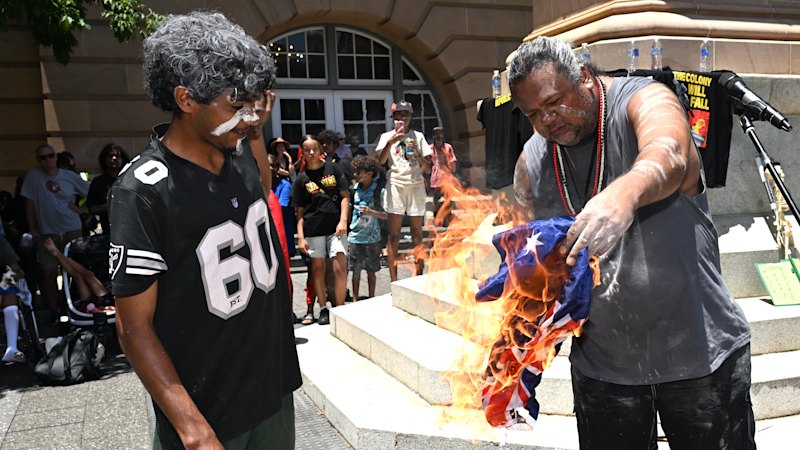
On January 27, 2026, Queensland Premier David Crisafulli condemned the burning of an Australian flag during an Invasion Day protest in Brisbane. This incident has reignited discussions regarding hate speech legislation in Australia. The protest drew several thousand participants who rallied against the date of Australia Day and showed solidarity with First Nations peoples. One protester was photographed burning the flag, an act that Crisafulli described as “as disgraceful as you get.”
Crisafulli asserted that the act transcended legitimate protest, indicating that states would support the inclusion of flag burning in hate speech laws. “I think it goes from legitimacy to being provocative,” he remarked. “It goes a step further, which is why there has been that justifiable condemnation of the act.” He emphasized the importance of the flag as a national symbol and called for tolerance and respect towards it.
Federal Response and Respectful Discourse
Federal cabinet minister Amanda Rishworth echoed Crisafulli’s sentiments, labeling the act as “absolutely disgraceful.” However, she stopped short of advocating for new Commonwealth laws to prohibit such actions. Rishworth highlighted the need for basic respect, stating, “There are a number of laws that exist at state jurisdictions… but quite frankly, people need to be responsible and actually think about how their behaviour affects others.”
She expressed that the general consensus among Australians would likely be that the act was unacceptable and that individuals should strive to be more respectful in their actions.
Protests Across the Nation
The Invasion Day protest took place at Queens Gardens in Brisbane, while a separate gathering of political figures and supporters occurred at the nearby Botanical Gardens. Pauline Hanson, leader of the One Nation party, addressed attendees, urging them to support her party amid rising popularity following a recent terror attack in Bondi.
Other speakers included One Nation senator Malcolm Roberts and Ralph Babet, a senator from the United Australia Party. The event was organized by Australia Marches, a right-wing group affiliated with March for Australia, which has held rallies in various state capitals.
In Melbourne, a related protest featured individuals associated with neo-Nazi groups. These participants reportedly chanted inflammatory slogans, referencing the so-called “great replacement” conspiracy. This rally ended at the steps of Victoria’s Parliament House and was attended by One Nation’s Victorian director, Warren Pickering, and local minor party candidates.
In Sydney, members of the National Socialist Network, Australia’s largest neo-Nazi group, were observed mingling with crowds at the March for Australia rally, while Invasion Day protesters gathered in Hyde Park. The contrasting events across cities illustrate the ongoing tensions surrounding national identity and the significance of Australia Day.
The discussions surrounding flag burning and hate speech legislation are likely to continue as Australia grapples with its colonial past and the rights of First Nations peoples. As these protests unfold, they highlight the complex dynamics of national identity and the need for respectful dialogue in a diverse society.