


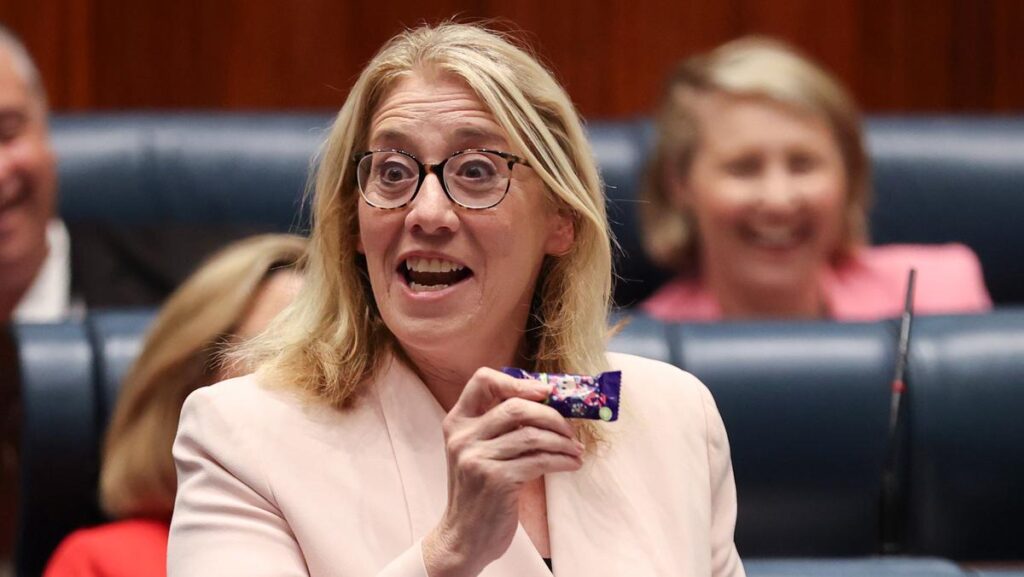
Question time at State Parliament on Thursday. Pictured is Deputy Premier Rita Saffioti holding a chocolate.
The financial landscape for Western Australia (WA) has shifted dramatically following a significant increase in expected revenue. The state’s budget update, released by Rita Saffioti, indicates that WA is on track to record a surplus exceeding $2 billion for the current financial year. This update also reveals an additional $2.4 billion in royalties from iron ore and gold due to rising commodity prices, pushing the total anticipated revenue from royalties to an impressive $9.968 billion.
Political Implications of Increased Revenue
This windfall complicates the ongoing discussions regarding WA’s share of the national Goods and Services Tax (GST). Despite Saffioti and Premier Roger Cook highlighting that WA’s current GST allocation remains below its population share of $10.4 billion, many on the east coast remain skeptical about the state’s financial needs. They argue that WA’s substantial revenue from royalties contradicts the claims for a fairer GST distribution.
The situation is further compounded by the fact that WA’s government is perceived to be “swimming in money.” This perception may hinder Saffioti’s efforts to convince east coast critics that the state deserves its current GST allocation. With the ongoing campaign aimed at winning over political leaders and commentators in eastern Australia, the recent surge in royalties could undermine these initiatives.
While Saffioti and Cook maintain that WA still provides a subsidy of $2.4 billion to other states and territories, the financial figures may not resonate with those who view the state’s burgeoning revenues as evidence of its ability to sustain itself without further GST aid.
Future Challenges and Public Sentiment
The upcoming review by the Productivity Commission of the 2018 GST deal adds another layer of complexity to the situation. The commission’s assessment of whether the current GST arrangement should continue could be influenced by the perception that WA is financially robust. Saffioti’s challenge now lies in demonstrating that the state still requires a fair share of the GST pie, particularly as the east coast sentiment shifts against further allocations.
Public sentiment in WA may also reflect concerns over the state government’s financial management. Many residents are questioning why, despite record surpluses, the government has chosen to reduce annual power bill rebates and why cost-of-living measures have not been more substantial.
With the festive season approaching, the metaphorical Christmas pudding of state revenues has indeed grown, but the citizens of WA are eager for a slice that reflects their contributions and needs. As Prime Minister Anthony Albanese navigates these complex dynamics, he faces the dual challenge of satisfying WA’s demands while also addressing the concerns of voters in other states.
In summary, WA’s recent financial successes may complicate the argument for a fair GST distribution, as the state grapples with public expectations and political realities in the coming months.