




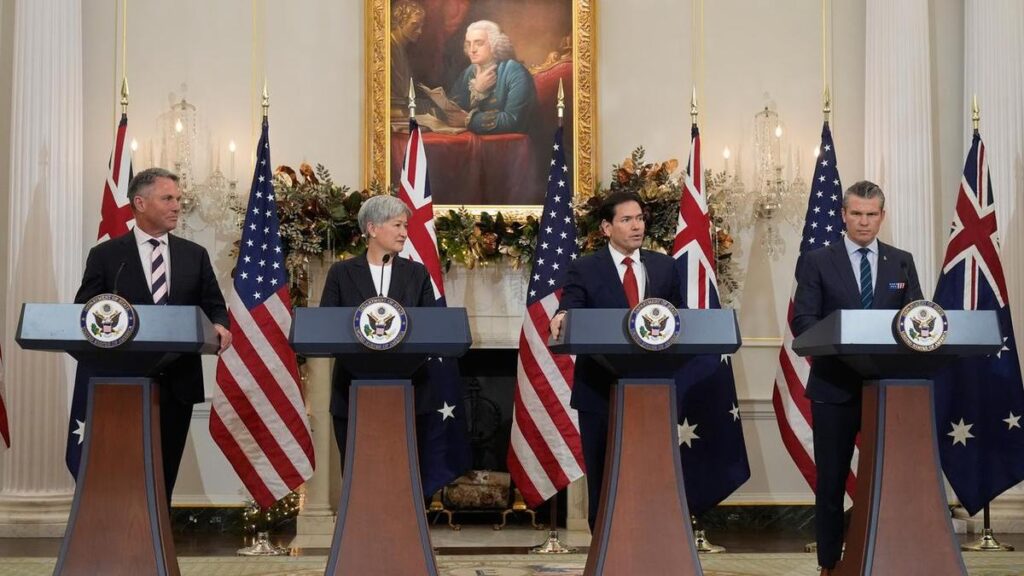
Australian Foreign Minister Penny Wong and Defence Minister Richard Marles are currently in Washington, D.C., for annual discussions with their U.S. counterparts. The meetings, which include U.S. Secretary of State Marco Rubio and Defence Secretary Pete Hegseth, aim to address key issues surrounding Indo-Pacific security, particularly concerning the increasing assertiveness of China in the region.
During their gathering at the State Department, the ministers are also expected to discuss the ongoing challenges posed by the conflict in Ukraine and the fragile ceasefire in Gaza. While no official mention of China was made in preliminary remarks, the country’s influence and activities in the South China Sea and towards Taiwan have been significant topics of concern in U.S.-Australia relations.
Rubio emphasized the strength of the partnership between the United States and Australia, stating, “This is a very strong partnership; it’s a strong alliance, and what we want to do is continue to build on it.” He highlighted the momentum behind the alliance, particularly in areas like critical minerals, defence production, and troop deployments.
A notable development in U.S.-Australia relations occurred in October 2023 when then-President Donald Trump and Australian Prime Minister Anthony Albanese signed a critical minerals deal at the White House. This agreement came in response to China’s implementation of stricter export regulations on critical minerals, essential for technologies ranging from mobile phones to military aircraft.
Rubio articulated the necessity for reliable supply chains for critical minerals, stating, “We have to have critical mineral supplies and supply chains that are reliable, and that are diverse, and not overly invested in one place where they can be used as leverage against us or our partners of the world.”
The discussions will likely touch on the implications of the AUKUS pact, an agreement formed during the Biden administration that involves the U.S., the UK, and Australia. Under this pact, the three nations committed to developing a fleet of submarines for Australia, powered by U.S. nuclear technology. Wong noted the pact’s importance, asserting that “the alliance has always been to ensure it delivers concrete benefits for our security and prosperity.”
The Australian Defence Minister reaffirmed the significance of the U.S.-Australia alliance, stating, “We are living in a much more contested world, where it really matters to be doubling down with friends and allies, and obviously, America is front and centre and foremost for Australia in that respect.”
Hegseth echoed this sentiment, praising Australia’s upcoming contribution of an additional US $1 billion (AUD $1.5 billion) to bolster U.S. submarine production capacity. This investment is seen as a crucial step in strengthening the AUKUS partnership for the benefit of all involved nations.
As the talks progress, both nations aim to solidify their collaborative efforts in the face of regional challenges and ensure that their alliance remains robust in promoting peace and security across the Indo-Pacific region.