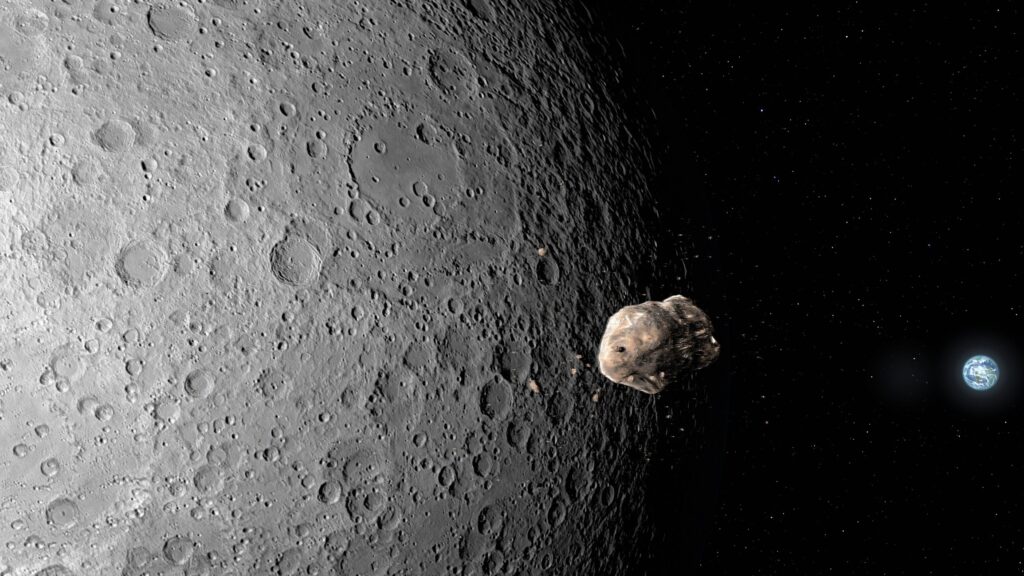
Astronomers have confirmed that Asteroid 2024 YR4 will not collide with the Moon in 2032, putting an end to speculation about a potential impact. Instead, the asteroid will make a safe pass approximately 13,200 miles from the lunar surface on December 22, 2032. This outcome means a missed opportunity for researchers, who had hoped to study the effects of a known asteroid striking a planetary body.
Recent observations from the James Webb Space Telescope, a collaboration between NASA and its European and Canadian counterparts, provided scientists with enhanced data to accurately calculate the asteroid’s trajectory. Initial concerns about the asteroid impacting Earth in 2032 were eliminated through follow-up observations, but a 4-percent chance of a lunar impact remained until the latest findings clarified its path.
Understanding the trajectory of near-Earth objects is crucial for assessing potential hazards. While a collision with the Moon would not have posed a threat to human life, it would have provided a rare scientific opportunity. An impact could have generated debris and allowed researchers to observe the event in real time, significantly enriching the study of asteroid behavior.
Details on Asteroid 2024 YR4
Asteroid 2024 YR4 measures approximately 200 feet in diameter, making it more than half the length of a football field. Discovered in late 2024 by the Asteroid Terrestrial-impact Last Alert System in Chile, the asteroid was initially thought to carry a slight risk of impacting Earth. As additional data became available, scientists updated their models, ultimately ruling out the possibility of an Earth impact.
NASA remarked on the importance of continuous observation, stating, “It’s typical to have initial observations and risk models updated once additional observational data is gathered.” As the asteroid moved further away, it became too faint for most telescopes to track, maintaining some uncertainty regarding its trajectory toward the Moon.
Innovative Tracking Techniques
Tracking Asteroid 2024 YR4 required innovative techniques from astronomers. Initially, many believed they would have to wait until 2028 for another observation opportunity. However, an international team identified two short windows on February 18 and February 26, 2024, allowing the James Webb Space Telescope to detect the asteroid.
The telescope’s capabilities only allow it to observe a small area of the sky, necessitating precise predictions of the asteroid’s location. By comparing its position with background stars mapped by the Gaia spacecraft, a European mission, scientists were able to refine the asteroid’s orbit and eliminate concerns about a lunar impact.
Despite the missed opportunity for a natural experiment, the successful tracking of Asteroid 2024 YR4 demonstrates the effectiveness of combining advanced technologies to monitor distant space objects. Organizations like NASA’s Center for Near-Earth Object Studies rely on such observations to ensure that potentially hazardous asteroids are accounted for.
The European Space Agency emphasized the importance of ongoing monitoring, stating, “The moon is safe, 2024 YR4 poses no danger, but the work continues. If a genuine danger ever emerges, we will not be caught unaware.” The efforts to track asteroids like 2024 YR4 contribute to humanity’s understanding of these ancient celestial objects, ensuring preparedness for any future threats.