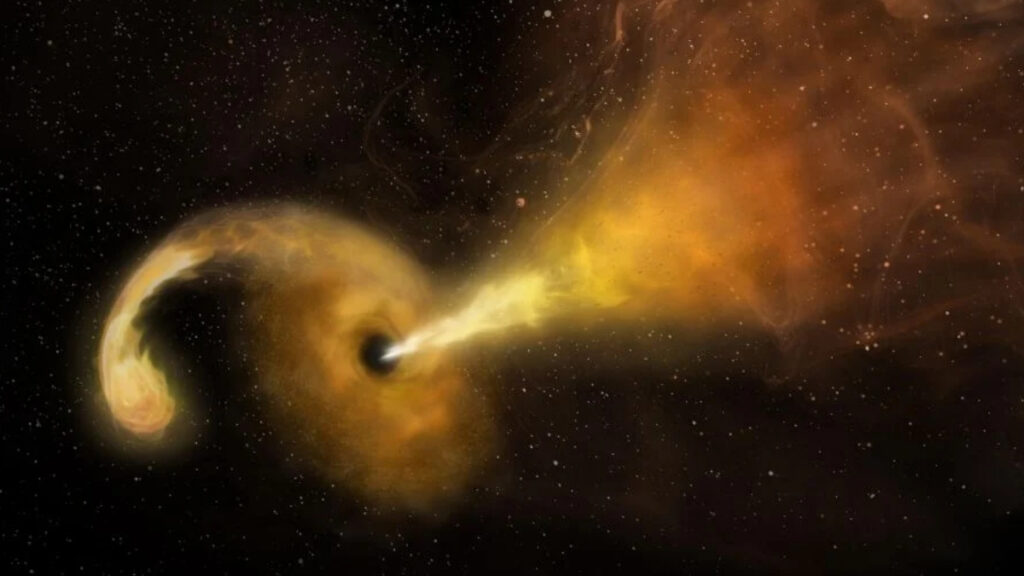
A distant supermassive black hole, designated as AT2018hyz, has been identified as significantly more powerful than previously thought. Researchers have revealed that this black hole emits energy at least one trillion times greater than that of the fictional Death Star from the Star Wars universe. This astonishing finding stems from ongoing observations of a tidal disruption event (TDE) where the black hole engulfed a star that ventured too close.
The TDE was first detected in 2018 by the All Sky Automated Survey for SuperNovae (ASASS-SN). Initial observations indicated a typical TDE, but subsequent studies revealed that the energy emissions began to escalate dramatically. This increase in energy output has been documented in a new paper published in The Astrophysical Journal, led by Yvette Cendes, an Assistant Professor in the Department of Physics at the University of Oregon.
New Research Highlights Ongoing Brightness Increase
Cendes and her colleagues have tracked the radio emissions from AT2018hyz, noting that these emissions continue to rise over time. The latest data spans from approximately 1370 to 2160 days after the initial disruption event. The researchers report, “We find that the light curves continue to rise at all frequencies during this time period.” This ongoing rise in brightness is particularly unusual, with the black hole now emitting energy that is 50 times greater than when it was first observed.
Two potential scenarios could explain this phenomenon. The first is a “delayed spherical outflow,” which suggests that the outflow from the black hole was launched approximately 620 days after the disruption. The researchers explain, “The physical evolution of the radius for a spherical outflow supports an outflow that was launched with a substantial delay of about 1.7 years relative to the discovery of optical emission.”
The second scenario involves an astrophysical jet, which could be traveling at relativistic speeds. According to the authors, “The radio emission from an off-axis jet will be suppressed at early times by relativistic beaming but will eventually rise rapidly when the jet decelerates and spreads.”
Implications and Future Observations
The implications of this research are significant. The energy output from AT2018hyz is comparable to that of a gamma-ray burst (GRB), known to be the most luminous explosions in the universe. This categorizes the black hole as one of the most energetic events observed to date.
Cendes has remarked on the uniqueness of this finding, stating, “This is really unusual. I’d be hard-pressed to think of anything rising like this over such a long period of time.” The study’s authors likened the black hole’s energy output to that of the Death Star, estimating that the black hole could emit energy between one trillion and 100 trillion times more than the fictional weapon.
While the findings are groundbreaking, researchers acknowledge the need for further observations to validate their conclusions. Cendes expressed the importance of continued study, noting, “If you have an explosion, why would you expect there to be something years after the explosion happened when you didn’t see something before?” With the discovery of AT2018hyz, the team intends to leverage their findings to seek more observation time on powerful telescopes to explore whether other black holes exhibit similar rising radiation patterns.
AT2018hyz stands out even among TDEs with delayed radio emissions. The researchers conclude, “We find that AT2018hyz is a unique TDE, and future observations should allow us to distinguish between these scenarios.” Ongoing research will continue to monitor the evolution of the outflow and the surrounding medium, offering valuable insights into the life cycle of supermassive black holes and their explosive environments.