




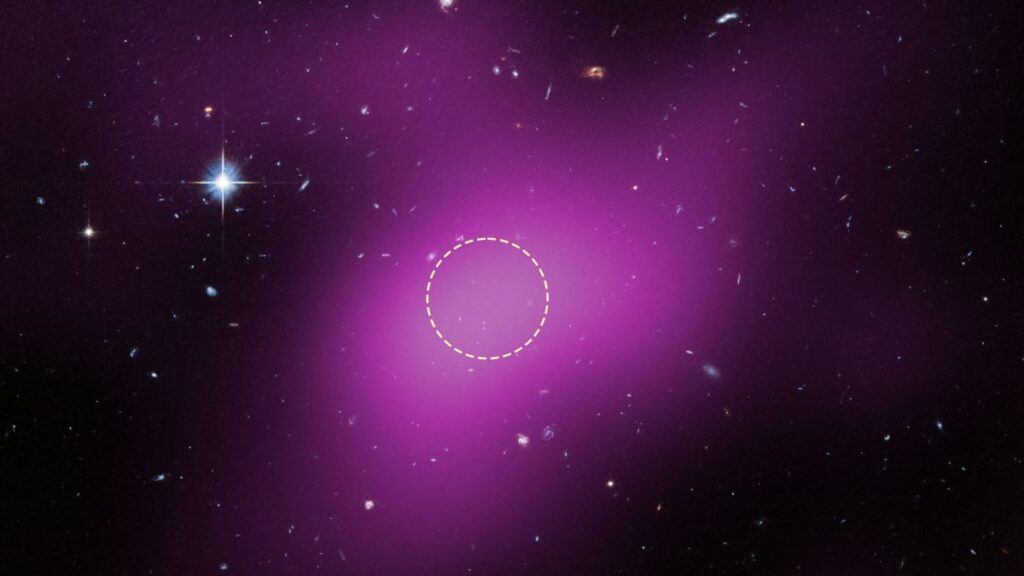
Astronomers have identified a mysterious object named Cloud-9, which may represent the remnants of a galaxy that never fully developed. Located approximately 14.3 million light-years away, near the spiral galaxy M94, Cloud-9 appears to lack stars and is primarily composed of dark matter enveloped in hydrogen gas. This rare celestial entity provides a unique opportunity to study the elusive nature of dark matter.
The discovery was made possible by a radio survey conducted with the Five-hundred-meter Aperture Spherical Telescope (FAST) in China. The object’s hydrogen content suggests it is relatively cool and compact. According to Andrew Fox, an astronomer at the Space Telescope Science Institute, “This cloud is a window into the dark Universe.”
Understanding the formation of galaxies is complex, but astronomers generally agree that they require a combination of stars, gas, and a halo of dark matter for stability. Dark matter, which constitutes much of the Universe’s mass, does not emit light, making it challenging to observe directly. Cloud-9 serves as a potential example of a Reionization-Limited H I Cloud (RELHIC), a theoretical structure that has been anticipated by cosmological simulations but remains difficult to identify.
Cloud-9 is distinguished by its lack of star formation. In a study published in The Astrophysical Journal Letters, researchers noted that the object is a dense, spherical accumulation of neutral hydrogen measuring about 4,900 light-years across. This gas has a mass equivalent to roughly one million solar masses and does not exhibit any rotation. Research indicates that maintaining the gas’s structure would require about 5 billion solar masses of dark matter.
The team, led by Gagandeep Anand of the Space Telescope Science Institute, conducted follow-up observations using the NSF’s Green Bank Telescope and the Very Large Array. The findings confirmed the absence of significant star formation within Cloud-9. Utilizing the Hubble Space Telescope, the researchers attempted to detect any hidden stars within the cloud but found no evidence of more than a few thousand solar masses’ worth.
According to Alejandro Benitez-Llambay, an astronomer at Milano-Bicocca University, “This is a tale of a failed galaxy.” He emphasized that the lack of stars supports theoretical models regarding galaxy formation, indicating that Cloud-9 represents a primordial building block of a galaxy that did not evolve.
Cloud-9 stands out among other candidates for RELHICs, such as an object designated J0613+52, which remains difficult to measure accurately. Its proximity to M94 provides a clear reference point for its distance, making Cloud-9 the most confidently identified RELHIC to date. Researchers believe it may eventually develop into a full galaxy, but for now, it serves as a fascinating remnant of cosmic evolution, shedding light on the early stages of galaxy formation.
The implications of this discovery extend beyond Cloud-9 itself. It highlights the challenges astronomers face in identifying and studying structures dominated by dark matter. As the researchers conclude, Cloud-9 “is likely among the rare RELHICs that inhabit the boundary between failed and successful galaxy formation.” This finding not only enriches our understanding of dark matter but also offers insight into the processes that shaped the Universe.