




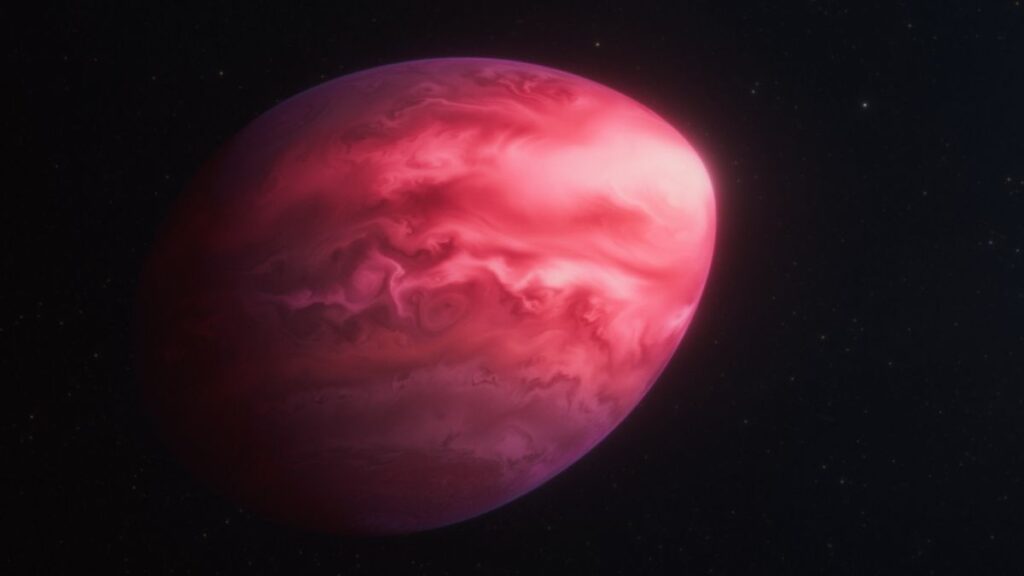
A newly identified exoplanet, designated PSR J2322-2650b, is capturing the attention of astronomers due to its bizarre characteristics. Located approximately 2,055 light-years away, this hot Jupiter orbits a millisecond pulsar and has a unique lemon shape caused by the intense gravitational pull of its host star. The discovery offers a fresh perspective on planetary evolution and challenges existing models in astrophysics.
This exoplanet exhibits an atmosphere rich in carbon vapor and potentially a helium-dominated interior. Its atmospheric conditions are remarkable, featuring rapid rotation at high speeds that contradict the planet’s own spin. According to Peter Gao, an astronomer at the Carnegie Earth and Planets Laboratory, “This was an absolute surprise… our collective reaction was ‘What the heck is this?’”
Unexpected Discoveries from the James Webb Space Telescope
The initial identification of PSR J2322-2650b occurred in 2017, when astronomers observed anomalies in the radio pulses from its host star, PSR J2322-2650. This pulsar, a type of neutron star, spins at an extraordinary speed of just 3.46 milliseconds, emitting beams of radiation that led to the detection of the planet, which has about 80 percent of Jupiter’s mass and completes an orbit every 7.8 hours.
Recent observations by the James Webb Space Telescope (JWST) have provided unprecedented insights into the atmospheric conditions of this exoplanet. Unlike typical observations that might focus on the star’s light, JWST can effectively analyze the planet illuminated by the pulsar without interference from the star’s radiation. According to Maya Beleznay of Stanford University, “This system is unique because we are able to view the planet illuminated by its host star, but not see the host star at all.”
The findings revealed an atmosphere with extreme temperatures, reaching around 1,900 Kelvin (approximately 1,630 degrees Celsius or 2,960 degrees Fahrenheit). This heating is intensified by gamma radiation emitted from the pulsar, indicating that the conditions are far harsher than what would occur from starlight alone.
Challenging Theories of Planetary Formation
The composition of PSR J2322-2650b raises intriguing questions about its formation. Instead of the expected presence of common molecules like water or methane, scientists detected molecular carbon, including forms like C3 and C2. Michael Zhang from the University of Chicago noted, “This is a new type of planet atmosphere that nobody has ever seen before.”
One theory suggests that PSR J2322-2650b might not have originated as a planet but rather as a helium star. This idea is supported by the behavior of similar pulsars known as black widows, which are characterized by their tendency to consume nearby stars. This consumption may explain the helium-rich interior and the unusual carbon atmosphere of this exoplanet.
Astrophysicist Roger Romani of Stanford University indicated that as the companion cools, the mixture of carbon and oxygen crystallizes, leading to the distinct atmospheric composition. He remarked, “Pure carbon crystals float to the top and get mixed into the helium, and that’s what we see.” Yet, the precise mechanisms that prevent oxygen and nitrogen from mixing into the atmosphere remain unclear, emphasizing the ongoing complexities surrounding this celestial body.
The study of PSR J2322-2650b has been published in The Astrophysical Journal Letters, and its unusual characteristics present an exciting opportunity for further research. Romani expressed enthusiasm, stating, “It’s nice to not know everything… I’m looking forward to learning more about the weirdness of this atmosphere.” As astronomers continue to unlock the mysteries of this peculiar world, it may redefine our understanding of planetary systems and the diversity of environments beyond our own.