Astronomers have achieved a significant breakthrough by capturing the most detailed images of a jet from a young star, providing confirmation for a theoretical model that has remained untested for over three decades. The findings, published in the journal Nature Astronomy, reveal intricate, ring-like structures within the jet, which document decades of explosive outbursts during the star’s formative years.
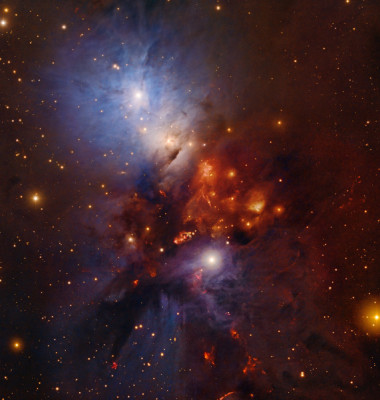
The international research team, which includes astronomers from The University of Manchester, utilized the advanced capabilities of the Atacama Large Millimeter/submillimeter Array (ALMA) in Chile. Their focus was on a high-velocity jet emanating from SVS 13, a binary star system located approximately 1,000 light-years from Earth. The high-resolution images captured by the team illustrate hundreds of nested molecular rings, each representing the aftermath of energetic bursts during the star’s early life.
These findings provide the first direct confirmation of a model that outlines the behavior of such jets, allowing researchers to reconstruct a chronological account of how forming stars consume and expel surrounding material. According to Gary Fuller, Professor of Astrophysics at The University of Manchester and co-author of the study, “ALMA has provided a level of precision we’ve never been able to achieve before. These images give us a completely new way of reading a young star’s history.”
Understanding the Formation of Stars
Stars like the Sun develop within dense clouds of gas and dust. During their initial stages, they experience energetic outbursts that disturb the material surrounding them. Concurrently, they emit rapid, collimated jets of gas, which play a critical role in regulating their material accumulation and impacting the evolution of the surrounding disc where future planets will form.
The research team identified over 400 individual rings in the jet from SVS 13, demonstrating how the jet’s shape and speed vary as it interacts with its environment. This data allowed the researchers to reconstruct the jet’s three-dimensional structure in unprecedented detail, a technique they refer to as “cosmic tomography.” Notably, they found that the most recently formed ring corresponds to a bright outburst observed from the SVS 13 system in the early 1990s. This connection marks the first instance where astronomers can directly link a specific burst of activity in a forming star to changes in the speed of its jet.
Collaborative Efforts Across Borders
The project involved researchers from 16 institutions across eight different countries, demonstrating a robust international collaboration. It was led by the Institute of Astrophysics of Andalusia (IAA-CSIC) in Spain, and builds upon earlier discoveries made using the US National Science Foundation’s Very Large Array (VLA), which first detected the jets from SVS 13.
ALMA is operated by the Joint ALMA Observatory, a collaboration among the European Southern Observatory (ESO), the National Radio Astronomy Observatory (NRAO), and the National Astronomical Observatory of Japan (NAOJ). The UK ALMA Regional Centre Node, which supports UK astronomers in their use of the ALMA observatory, is funded by the UK Science and Technology Facilities Council (STFC).
This latest research not only enhances understanding of star formation but also provides vital insights into the processes that shape the planetary systems around these stars. The detailed findings pave the way for future investigations into the evolution of stars and their potential planetary companions, marking a significant milestone in astrophysical research.
The full study is available in the journal Nature Astronomy, under the title: “Bowshocks driven by the pole-on molecular jet of outbursting protostar SVS 13.” The publication can be accessed via DOI: 10.1038/s41550-025-02716-2.