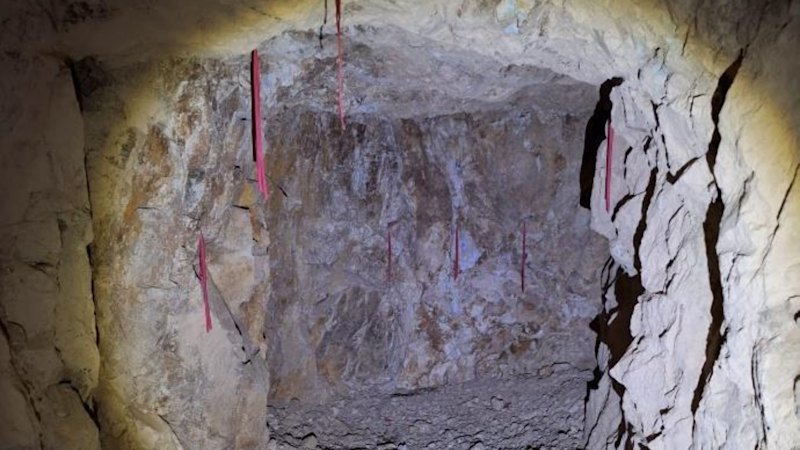
Locksley Resources has made significant strides in identifying new antimony targets at its Desert Antimony Mine (DAM) in California. This development follows a comprehensive technical review that utilized high-resolution underground mapping, revealing multiple antimony-bearing structures within the mine, which is part of Locksley’s Mojave project in San Bernardino County. The DAM is strategically located adjacent to the Mountain Pass operation, the only large-scale rare earths mine in North America, operated by MP Materials.
The recent underground mapping has identified the Beefeater Shear, a substantial 10-15 meter wide north-south corridor connecting the DAM with the prospective Hendricks target. According to management, the Beefeater Shear exhibits similar structural characteristics and alteration signatures as the high-grade DAM system, heightening the potential for new antimony discoveries at the site. The mapping program has also confirmed the geometry of stibnite veins and offsetting structures, providing crucial insights into the target mineralization for the upcoming drill program.
Technical Review Enhances Exploration Strategy
The stage-three technical review concentrated on the Northern Block of the Mojave project, incorporating high-resolution underground mapping and regional structural analysis. Notably, the structural insights indicate that previously pinched-out veins are not terminations but rather cut off by locally offset blocks due to east-west shearing. This geological understanding allows Locksley to better target the faulted extensions of high-grade lodes by accurately determining the displacement of the east-west shear zones.
Kerrie Matthews, managing director and chief executive officer of Locksley Resources, stated, “The technical findings from this geological mapping campaign have significantly enhanced our exploration strategy at Mojave. By mapping the underground workings at DAM, we have essentially ‘unlocked’ the geometry of the system. We now see exactly how high-grade, mineralized blocks have been created by later structural events, allowing us to target extensions with greater certainty.”
The positive findings also coincide with recent results from a high-resolution radiometric survey, which suggest promising outcomes for planned target sampling and drilling across several identified prospects. The Beefeater Shear’s altered structure presents a compelling opportunity for the company to intensify its exploration efforts in the quest for multiple mineralized structures across the more than 40-square-kilometer project site.
Locksley has primarily focused its mapping efforts south of the Hendricks prospect, where shear zones and quartz veins matching the geological characteristics found at the DAM have been identified. The north-south striking shear zones run parallel to the primary mineralized trends and exhibit intense goethite alteration, a significant indicator of weathered primary mineral sulphides. Management believes that the mineralized system in the Northern Block may be more extensive than previously acknowledged, particularly following the discovery of quartz-dominated shear-breccia veins, which can indicate hydrothermal events that localize high-grade antimony mineralization.
Recent Sampling Yields Promising Results
In a separate but related development, Locksley Resources has reported impressive results from a recent batch-sampling program at the DAM. These findings build on an earlier bulk sample of 325 kilograms, which produced a robust grade of between 7.6 and 7.8 per cent antimony. The initial flotation work revealed a premium grade concentrate containing 68.1 per cent antimony.
The latest sampling campaign yielded an additional 287 kilograms of antimony-rich material from historical underground workings. This effort focused on key zones to refine pilot plant design and optimize metallurgical performance from the ore. Eleven samples across three batches produced significant grades, with a peak of 26.1 per cent antimony in the second batch. The overall weighted average grade from all samples reached 18.7 per cent antimony, representing a substantial increase compared to previous bulk sampling results.
The Desert Antimony Mine’s proximity to the Mountain Pass mine, which produces essential light rare earth elements like neodymium and praseodymium, positions Locksley Resources strategically in the context of the United States’ efforts to secure domestic supplies of high-value rare earths. As the company prepares for its upcoming exploration programs, it aims to convert geological potential into concrete discoveries, potentially contributing to the nation’s critical supply chain efforts.