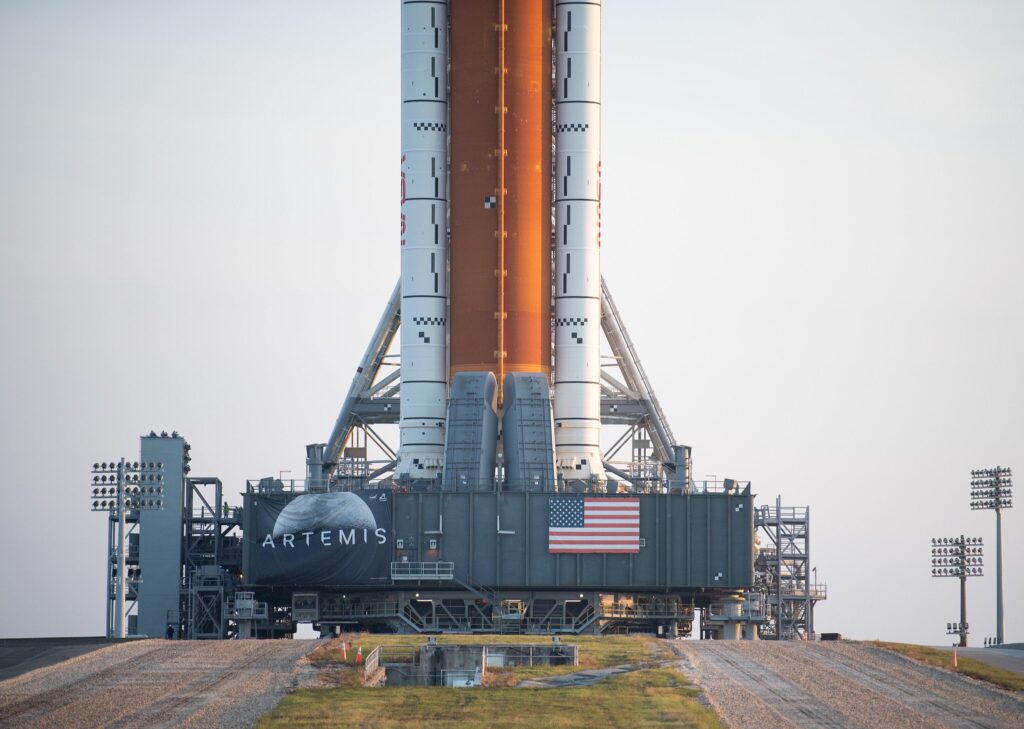
NASA’s Space Launch System (SLS), the agency’s mega moon rocket, began its journey to the launchpad at Cape Canaveral, Florida, on January 17, 2024. This rollout signifies a critical milestone for the upcoming Artemis II mission, which aims to send four astronauts on a historic journey into deep space. The mission marks NASA’s first crewed lunar expedition in over 50 years.
As the SLS and its Orion spacecraft make their way to the launchpad, the teams will conduct a series of final ground tests. The rollout process will commence at 7 a.m. ET, with the rocket making its exit from the Vehicle Assembly Building on a massive crawler-transporter. Launch director Charlie Blackwell-Thompson noted that the journey will proceed at a speed of just under 1 mph, taking approximately eight to ten hours to reach its destination.
Once the SLS arrives at the launchpad, crews will connect the rocket and capsule to ground systems, and the crew access arm will be positioned. If the upcoming fueling dress rehearsal is successful, NASA could target a launch opportunity as early as February.
Understanding the Power of SLS
While NASA’s SLS generates approximately 8.8 million pounds of thrust, making it one of the most powerful rockets, it is no longer the leader in this category. SpaceX’s Starship now produces an estimated 16 to 17 million pounds of thrust, surpassing SLS. Although SLS claimed the title during its Artemis I debut, Starship has since conducted multiple successful tests.
Despite its current standing, SLS remains flight-ready for crewed missions, while Starship has yet to carry any payloads. With Artemis II, SLS could set a new record as the most powerful rocket to launch humans into space. The four main engines of SLS utilize around 700,000 gallons of ultra-cold fuel and can generate enough power to lift eight Boeing 747s simultaneously.
In terms of size, SLS stands at 322 feet tall, taller than both the Statue of Liberty and Big Ben. Although it surpasses the Space Shuttle when fully assembled, it is still shorter than the Saturn V rocket from NASA’s Apollo program. Starship, on the other hand, is more than 80 feet taller than SLS.
Key Features of SLS
SLS is currently the only rocket capable of launching the Orion spacecraft, which has been renamed Integrity by the Artemis II crew. Orion serves as both a transport vehicle and living quarters for astronauts during long-duration missions. For Artemis II, the spacecraft will venture approximately 5,000 miles beyond the moon, potentially establishing a new distance record for human spaceflight. Upon its return, Orion will splash down in the Pacific Ocean.
Built on the legacy of the Space Shuttle program, SLS incorporates significant components from the shuttle, which operated from 1981 to 2011. Key features include the shuttle’s orange external tank, which has been elongated to form the rocket’s core stage, and the four main engines that power this core. Unlike previous missions, these engines will not be reused and will be discarded after flight.
To enable the SLS to reach the moon, engineers made substantial modifications to the original design, including the removal of reusable features such as parachutes and landing sensors. These changes increased the rocket’s payload capacity by approximately 2,000 pounds, allowing Orion to achieve speeds up to 24,500 mph, essential for a moonbound trajectory.
Cost and Economic Impact
SLS has often been referred to as “America’s rocket,” recognized as a national asset akin to a custom-built military aircraft carrier. The focus on cost control was not the primary concern during its development. A spending law from 2010 mandated the rocket’s design and business model, aimed partly at protecting jobs during the Great Recession.
Currently, about 3,800 suppliers across all 50 states contribute to the SLS and Orion programs. However, SLS has earned a reputation as potentially the most expensive rocket ever constructed. In a report from 2022, NASA’s inspector general estimated that each Artemis launch would incur a cost of $4.1 billion, with approximately half of that figure attributed to the SLS program alone.
As NASA prepares for the Artemis II mission, the SLS stands as a testament to human ingenuity and ambition in space exploration, poised to usher in a new era of lunar exploration.