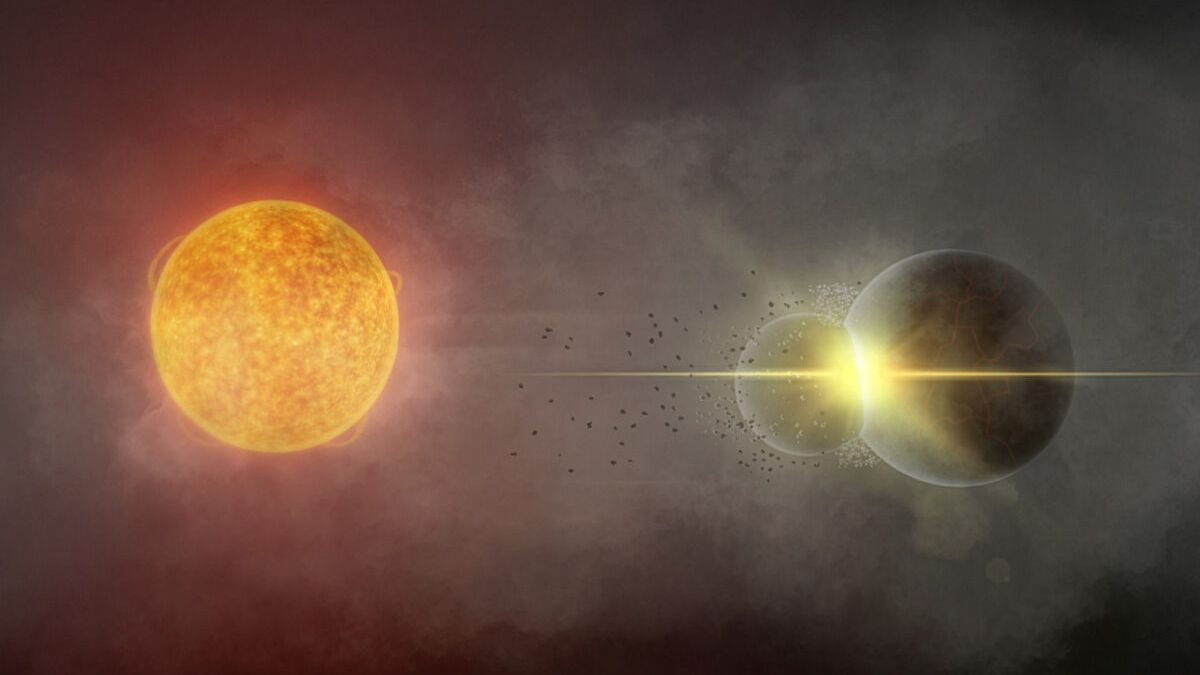
Recent research sheds new light on the longstanding mystery of the moon’s origin, suggesting that it was formed through explosive ejection rather than from a giant impact with Earth. This theory challenges the traditional understanding that has dominated lunar science for decades.
George Darwin, the son of the famed naturalist Charles Darwin, first proposed a model over a century ago. In his view, tidal and centrifugal forces on a rapidly rotating proto-Earth were responsible for flinging material into orbit, eventually coalescing to form the moon. This idea has been a cornerstone of lunar research but has faced scrutiny as new evidence emerges.
Exploring Explosive Ejection
Recent studies indicate that the moon’s formation may have involved a different mechanism. Researchers suggest that explosive ejection of materials, possibly due to intense volcanic activity or impacts from other celestial bodies, played a significant role. This process could have released vast amounts of debris into space, creating the conditions necessary for the moon’s formation.
The theory of explosive ejection aligns with findings from lunar rock samples brought back by the Apollo missions. Analysis of these samples reveals that the moon’s composition closely resembles that of Earth, supporting the idea that they share a common origin.
In addition, advancements in computer simulations have allowed scientists to model the dynamics of early Earth more accurately. These simulations demonstrate how material could be expelled into orbit through explosive events rather than a singular catastrophic impact.
Implications for Planetary Science
This new understanding of the moon’s formation has significant implications for planetary science. It challenges existing models that have been used to understand not only the moon but also other celestial bodies in the solar system. The findings encourage a reevaluation of how scientists interpret lunar geology and the evolutionary history of Earth and its satellite.
Moreover, the explosive ejection theory opens up avenues for further research into other moons and planetary systems. Scientists are now considering how similar processes might explain the origins of moons around gas giants or even exoplanets.
The exploration of the moon’s origins has been a captivating subject for researchers and enthusiasts alike. As new evidence challenges established theories, the scientific community is reminded of the complexities involved in understanding our solar system’s history.
The quest to uncover the truth about the moon’s formation continues, driven by both curiosity and the desire to understand our place in the cosmos. As researchers delve deeper into this celestial mystery, they not only seek answers about the moon but also broader insights into the processes that govern planetary formation throughout the universe.