A recent theoretical paper proposes that the masses of fundamental particles such as the Z and W bosons may result from the twisted geometry of hidden dimensions rather than the widely accepted Higgs field. This groundbreaking research, led by theoretical physicist Richard Pinčák from the Slovak Academy of Sciences, offers a fresh perspective on particle physics and may help resolve some longstanding questions within the Standard Model.
The Higgs field, introduced in the 1960s, has been crucial in explaining why fundamental particles possess mass. It likens the Universe to an invisible sticky substance, where particles interact differently depending on their properties. Heavier particles, like the W and Z bosons, move through this medium as though they are wading through mud, while lighter particles, such as electrons, glide through more easily. The existence of the Higgs boson was confirmed at the Large Hadron Collider in 2012, validating the Higgs mechanism as a key component of particle mass.
Despite this achievement, there remain unanswered questions regarding the properties of the Higgs field itself, as well as phenomena like dark matter and dark energy. Pinčák and his team have turned to a new framework involving a seven-dimensional space known as a G2 manifold. This mathematical construct allows physicists to explore complex geometries that could influence particle masses.
Exploring the G2 Manifold
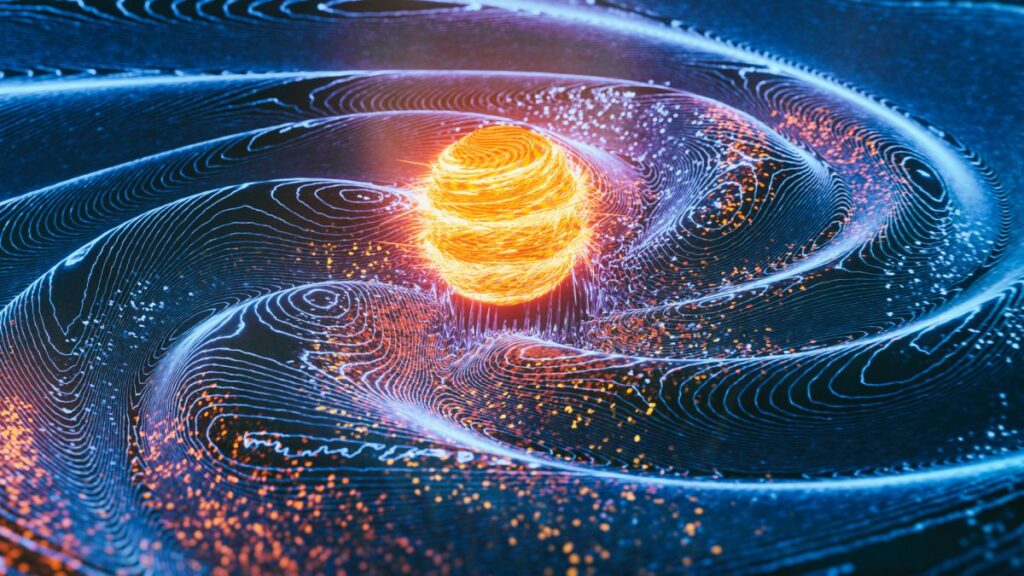
A manifold is a mathematical term representing a shape that can have curves and twists. The G2 manifold is a specific seven-dimensional structure that can evolve over time, revealing unique properties. The researchers developed a novel equation, termed the G2-Ricci flow, to model how these manifolds change.
Pinčák explains, “As in organic systems, such as the twisting of DNA or the handedness of amino acids, these extra-dimensional structures can possess torsion, a kind of intrinsic twist.” As the team studied the G2 manifold’s evolution, they discovered stable configurations known as solitons. These solitons could potentially offer a geometric explanation for phenomena such as spontaneous symmetry breaking, a critical concept in particle physics.
The research suggests that the torsion within the G2 manifold could imprint itself onto the W and Z bosons, resulting in mass in a manner similar to that of the Higgs mechanism. This new perspective does not only challenge existing theories; it may also link to the ongoing expansion of the Universe.
The Potential of the Torstone
An intriguing aspect of this research is the theoretical particle the team has dubbed the Torstone. If the torsion behaves like a field, it might produce particles in a way analogous to how the Higgs field gives rise to the Higgs boson. The researchers speculate that the Torstone could be detectable through anomalies in particle colliders or irregularities in the cosmic microwave background.
While the existence of the Torstone is yet to be proven, this study opens new avenues for exploration in particle physics. Pinčák concludes, “Nature often prefers simple solutions. Perhaps the masses of the W and Z bosons come not from the famous Higgs field, but directly from the geometry of seven-dimensional space.”
This innovative research has been published in the journal Nuclear Physics B and marks a significant step in the quest to understand the fundamental nature of the Universe. As scientists continue to investigate these theories, the possibility of uncovering new physical principles remains tantalizingly close.