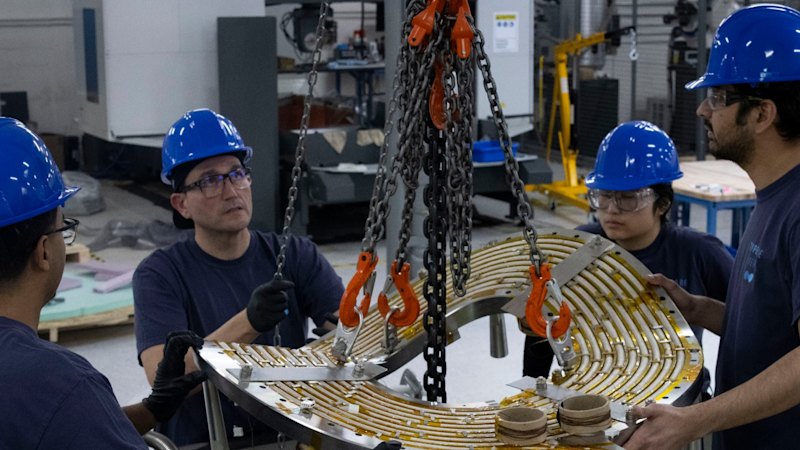
A nuclear fusion company, Type One Energy, is making ambitious plans to establish a fusion power plant in Australia by the middle of the next decade. This announcement comes despite the fact that no commercial fusion power plants currently operate anywhere in the world. The company aims to harness fusion technology, which mimics the processes of the sun by using extreme heat and powerful magnetic fields to fuse atoms together, thereby generating vast amounts of clean energy.
Type One Energy is developing a stellarator testbed in Tennessee, where it has signed a letter of intent with the local energy authority to construct a 350 MW commercial fusion reactor. The projected cost for each plant is approximately $2 billion. The firm asserts that fusion technology is ready for deployment and could soon become a pivotal part of the global energy landscape.
Despite this enthusiasm, many Australian fusion experts remain skeptical. Currently, only one experiment worldwide has managed to produce more power than it consumed, but the results resembled more of an explosion than a reliable reactor. Significant scientific and technical challenges remain; the Commonwealth Scientific and Industrial Research Organisation (CSIRO) has not included fusion in its energy modelling. Yet, interest from entrepreneurs and venture capitalists continues to grow, with global private investment in fusion exceeding $10 billion.
Charlie Baynes-Reid, Chief Financial Officer of Type One Energy, expressed confidence about the project. “We are intending to break ground on the [US] power plant by 2028-29,” he said. “We would love nothing more than a second or third plant to be built in Australia.” He emphasized that the focus should not be on whether fusion will work, but rather on the efficiency of future power plants.
Nuclear fusion operates differently from nuclear fission, the process used in conventional reactors. In fusion, two hydrogen atoms combine to form a helium atom, releasing energy in the process. This is the same principle that powers the sun, where immense gravitational forces and high temperatures facilitate the fusion of hydrogen into helium. Fusion reactions promise significantly more energy than fission without the generation of greenhouse gases.
According to the International Atomic Energy Agency, fusion has the potential to deliver “virtually limitless clean, safe, and affordable energy” to meet global demands. While the fundamental science of achieving nuclear fusion is established, the challenge lies in maintaining a stable and sustained reaction. Emeritus Professor John Howard, who oversaw the Australian National University’s experimental fusion reactor, notes that the real difficulty is akin to “keeping a star inside a magnetic bottle.”
Type One Energy’s stellarators aim to confine plasma—a superheated gas of atoms stripped of their electrons—using powerful magnets. These twisted, hollow donut-shaped devices must withstand temperatures exceeding 100 million degrees Kelvin while keeping the surrounding superconducting magnets below zero.
Recent achievements in fusion technology include a record set by the German W7-X stellarator, which successfully maintained a controlled fusion reaction for a brief period. Baynes-Reid believes that the next step is to scale up these models to a size suitable for grid connection. The company proposes utilizing existing infrastructure from decommissioned coal plants, which already have established grid connections.
Despite the optimism from Type One Energy, some scientists caution against overconfidence. The record set by the W7-X lasted only 47 seconds, and challenges remain. Two key hurdles are the need for tritium breeding and managing neutron degradation of reactor components. Tritium, a radioactive isotope of hydrogen needed for the fusion process, is scarce and must be generated within the reactor itself for sustained operation.
Howard expressed concerns about the commercial viability of fusion technology at this stage, stating, “Their prospectus is fairly optimistic. I’d love to say it was grounded in demonstrated achievements, but that’s not quite the case yet.” He mentioned that he would hesitate to invest personally in such projects.
The timeline for Type One Energy to deliver a working fusion plant in the US is set for 2034, coinciding with Australia’s commitment to reduce emissions between 62 and 70 percent from 2005 levels by 2035. This ambitious goal may necessitate that 95 percent of Australia’s electricity generation comes from renewable sources within the next decade.
The ITER project, the world’s largest and most powerful experimental fusion reactor, has been under construction since 2013 and is estimated to cost around $66 billion. It aims to achieve breakeven and test tritium breeding but is not expected to achieve first plasma until 2034 at the earliest.
Dr. Nathan Garland, a fusion researcher at Griffith University, remains hopeful about the future of fusion but advises caution. He emphasizes the urgency of addressing current climate challenges with proven technologies before relying on those still in development. “I’m a believer in this, but on the timescales, I may not be as aggressive as private industry,” he said.
As Type One Energy moves forward with its plans, the future of fusion energy remains a topic of both excitement and skepticism. While the potential for revolutionizing the energy sector is evident, significant challenges must be overcome to make fusion a practical reality.