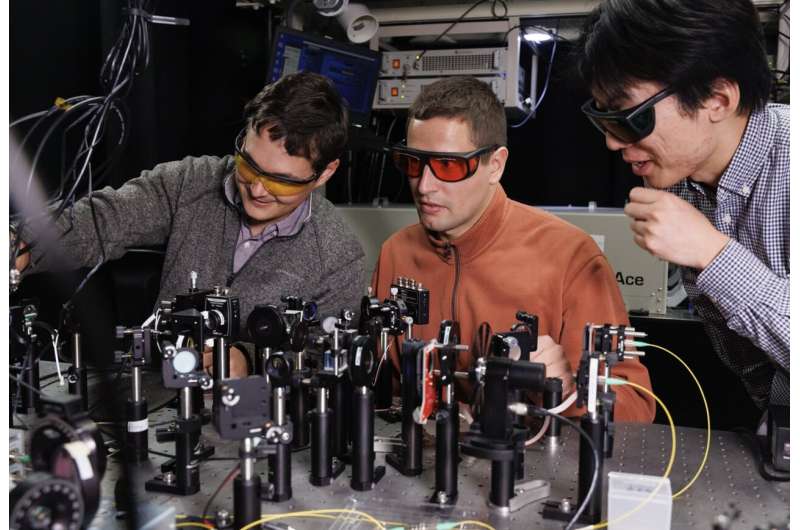
Researchers at Purdue University have developed a groundbreaking method for all-optical modulation in silicon devices, utilizing an innovative electron avalanche process. This advancement, detailed in a study published in Nature Nanotechnology on December 11, 2025, could significantly enhance the capabilities of photonic circuits and quantum information technologies.
Historically, the effectiveness of photonic and quantum systems has been limited by the weak optical nonlinearity of materials used in their fabrication. A strong optical nonlinearity is essential for creating ultrafast optical switches, which play a crucial role in fiber optic communication systems and quantum technologies. The new approach developed by Purdue researchers promises to address these limitations.
The study’s lead author, Demid Sychev, explained that their lab has focused on developing ultrafast single-photon sources. However, the realization of high-speed applications also requires equally rapid single-photon detectors. This gap prompted the team to investigate the potential for an ultrafast modulator that could switch a macroscopic optical beam in response to a single photon.
After reviewing existing literature, the researchers recognized that while current methods for detecting ultrafast pulses are well established, they often depend on high-power beams, rendering them ineffective at the single-photon level. “This led us to consider whether it might be possible to build an ultrafast modulator capable of switching a macroscopic optical beam in response to just a single photon,” Sychev stated.
The breakthrough came with the identification of the electron avalanche effect, a well-known phenomenon that drives many single-photon detectors. The project, under the guidance of Vladimir M. Shalaev, aimed to connect optical modulators with electron transistors. Shalaev noted, “If we are able to employ photons for modulation and switching—the function that is currently realized by an electronic transistor—we could process information at higher speeds and thus revolutionize computing, communication, sensing, and other related technologies.”
In their experiment, the researchers generated strong optical nonlinearities by shining a beam at single-photon level intensity onto silicon. This process initiated the electron avalanche, where one energized electron liberated additional electrons from atoms, creating a cascading effect. Sychev elaborated, “The process we use is very similar to what occurs in a standard photodiode when measuring light’s intensity.”
The silicon-based semiconductor’s increased metallicity—its enhanced ability to conduct electricity—was a key factor in this discovery. The enhanced reflectivity of silicon also plays a vital role in realizing all-optical modulation. The team developed a method that could effectively utilize the avalanche process to amplify the density of free electrons in silicon, even when only a single photon was absorbed.
The advantages of this new modulation strategy include a significant increase in the nonlinear refractive index of the silicon device, making it more effective than existing materials. “The principle we outlined is unique in its ability to produce strong interactions between two optical beams, independent of their power or wavelength,” Sychev remarked.
Moreover, this approach relies on the intrinsic properties of semiconductors, which could mitigate challenges associated with external electronic components. The researchers anticipate that their findings could facilitate the development of ultrafast optical switches, paving the way for advanced photonic circuits and quantum information technologies.
The team believes their approach has the potential to enable sub-terahertz and terahertz clock rates, functioning at room temperature without the need for optical cavities. “Taken together, the features of our approach make it ideally suited for building ultrafast, large-scale all-optical photonic circuits,” Sychev stated.
While the initial results are promising, the method does not currently maintain coherence between interacting beams. Nonetheless, the researchers aim to refine their technique to potentially enable all-optical quantum circuits that operate at extremely high clock rates, which could be integral to future quantum computing applications.
As the research progresses, the team plans to conduct further theoretical and experimental studies to improve their proposed strategy. “We envision that this concept could open an entirely new research direction, ultimately enabling fully optical photonic circuits for both quantum and classical applications,” Sychev concluded.
This advancement marks a significant step toward overcoming limitations in the realm of photonics and quantum technologies, with implications that could transform multiple fields reliant on optical systems.