Recent advancements from researchers at Carnegie Mellon University and the University of California, Riverside, have introduced an innovative method to manipulate the flow of excitons in two-dimensional materials known as moiré superlattices. This technique, detailed in a paper published in Nature Communications on December 21, 2025, has significant implications for the development of quantum and optoelectronic devices.
Excitons, which are pairs of bound electrons and holes, play a crucial role in energy transport within semiconductors. These quasiparticles are particularly significant in transition metal dichalcogenides, which consist of a transition metal combined with two chalcogen atoms. The research team focused on stacking two layers of these materials with a slight rotational mismatch, creating a structure that allows for enhanced control over exciton dynamics.
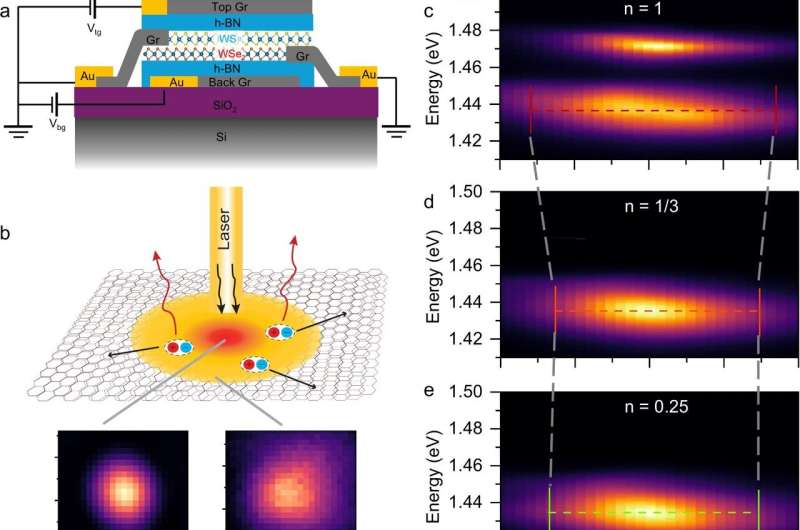
In their study, the researchers employed optical techniques to stimulate the formation of excitons between the two layers of transition metal dichalcogenides. By adjusting the density of electrons through electrostatic doping, they were able to measure the exciton flow, referred to as diffusivity. According to senior author Sufei Shi, this study builds on previous work exploring quantum many-body phenomena arising from strong electron-electron and exciton-exciton interactions.
Shi explained, “We controlled the exciton diffusivity in our system by electrostatic doping, which controls how many electrons are in the moiré superlattices.” This manipulation revealed striking results; when the density of electrons reached a level sufficient to create a Mott insulator state, the diffusivity of excitons increased by as much as 100 times. In contrast, when electrons were organized into a rigid, crystal-like formation, known as Wigner crystal states, exciton diffusivity was noticeably suppressed.
Implications for Quantum Devices
The findings from this research present new avenues for enhancing exciton diffusivity in transition metal dichalcogenide-based devices. This approach could facilitate the engineering of specific excitonic states, which may lead to advancements in quantum computing and optoelectronics. Sufei Shi noted, “With the robust exciton in 2D semiconductors, it has been widely proposed to use excitons for possible devices, which use excitons rather than electrons as information carriers.”
A critical challenge has been the difficulty in controlling excitons, as they are charge neutral and do not respond to electric fields like electrons. By utilizing the interactions between correlated electrons and excitons, the researchers have achieved a method of electrically tuning exciton diffusivity, which could revolutionize how these materials are used.
The research team’s work sets the stage for future studies aimed at further exploring the control of exciton diffusivity through electric fields or nanoscale device patterns. Shi expressed excitement about the potential of this research, stating, “We are also interested in exploring how exciton-exciton interaction can be used to further manipulate the exciton diffusion.”
This groundbreaking research not only contributes to the understanding of fundamental physics but also opens the door to practical applications in emerging technologies. As researchers build on these findings, the potential for new quantum devices and advances in optoelectronic technologies continues to expand, promising a significant impact on future developments in the field.