


Researchers at the Helmholtz-Zentrum Dresden-Rossendorf (HZDR) have identified new oscillation states in magnetic vortices, known as Floquet states. This discovery, reported on January 8, 2026, marks a significant advancement in the field of physics, with potential applications in connecting diverse physical systems, including electronics and quantum devices.
The study reveals that unlike previous experiments that required intense laser pulses for generating these oscillation states, a much simpler approach using magnetic wave excitation suffices. This breakthrough not only enhances understanding in fundamental physics but also presents prospects for innovative technologies that could unify various computing paradigms.
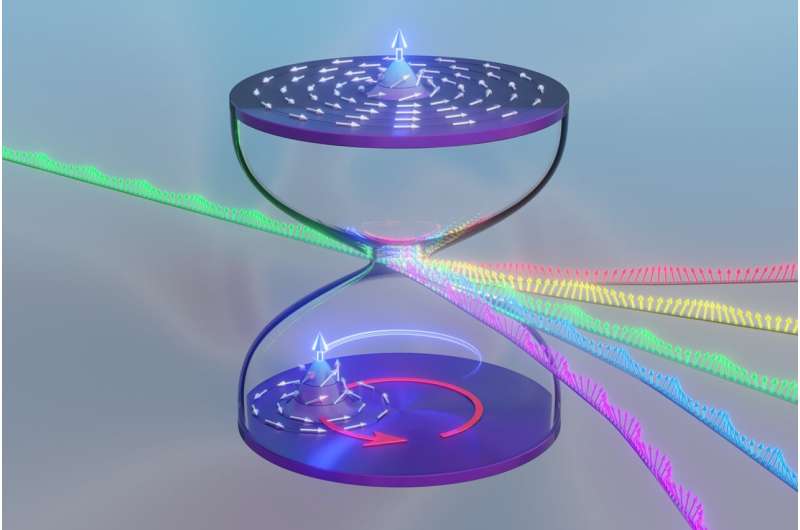
Magnetic vortices arise in ultrathin disks made from materials like nickel–iron, where elementary magnetic moments align in circular patterns. When these vortices are disturbed, they produce wave-like excitations, referred to as magnons. Dr. Helmut Schultheiß, project leader at HZDR, highlighted the significance of magnons, stating, “These magnons can transmit information through a magnet without the need for charge transport.” This ability positions them as promising candidates for future computing technologies.
Uncovering New States
In their research, the HZDR team focused on smaller magnetic disks, reducing their size from several micrometers to hundreds of nanometers. Initially aimed at investigating neuromorphic computing, the researchers observed a surprising phenomenon: some disks displayed a series of finely split resonance lines instead of the expected single peak—an occurrence termed a frequency comb.
At first, the team suspected their findings were mere measurement artifacts. However, repeated experiments confirmed the phenomenon, leading to the understanding that they had discovered a new state of matter. The key to this finding lies in the work of Gaston Floquet, a mathematician who established that systems subjected to periodic driving can exhibit entirely new states.
In magnetic vortices, the researchers found that these Floquet states could emerge spontaneously through strong excitation of magnons. This causes the vortex core to undergo slight circular movements, which in turn modulate the magnetic state and create a frequency comb effect.
Implications for Future Technologies
What stands out about this discovery is its energy efficiency. The process can be initiated with very low energy inputs, around microwatts, which is significantly less than what traditional setups require. This efficiency opens up exciting possibilities for synchronizing disparate systems, potentially linking ultrafast terahertz phenomena with conventional electronics and quantum components.
Dr. Schultheiß refers to this innovation as a “universal adapter,” likening it to a USB adapter that facilitates compatibility between devices with different connectors. The implications of this research could reach far beyond fundamental physics, influencing the design of new computing architectures that integrate magnonic signals, electronic circuits, and quantum systems.
The HZDR team plans to investigate whether the principles observed can extend to other magnetic structures, which may further enhance the understanding of magnetism and its applications. “Our discovery opens new avenues for addressing fundamental questions in magnetism,” Dr. Schultheiß emphasized, “and it could eventually serve as a valuable tool to interconnect the realms of electronics, spintronics, and quantum information technology.”
This research was documented in the journal Science, highlighting the collaborative efforts of the HZDR team and their commitment to advancing scientific knowledge in this exciting field.