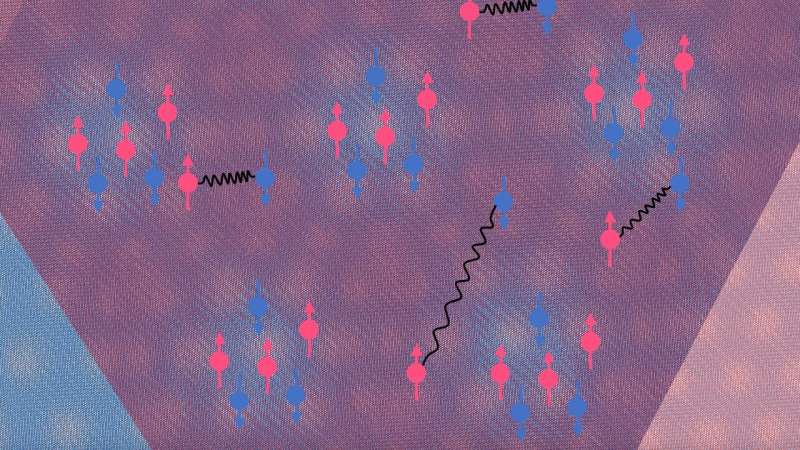
A recent study has revealed strong superconductivity in a novel structure known as a supermoiré lattice, formed by overlapping twisted trilayers of graphene. Conducted by researchers from the Ecole Polytechnique Fédérale de Lausanne and Freie Universität Berlin, the findings, published in Nature Physics on February 15, 2026, could significantly influence the design of advanced quantum materials.
The researchers began their work with the intention of creating a device featuring identical twist angles in the trilayer graphene. However, during their measurements, senior author Mitali Banerjee noted unexpected results. Her student, Zekang Zhou, discovered that the phase diagram of the device differed fundamentally from what is typically observed in magic-angle twisted trilayer graphene.
Zhou observed that the signals recorded exhibited asymmetry when an electric field was applied in different directions. This asymmetry indicated that the newly created device behaved differently than expected, leading to the emergence of a resistive state in several distinct regions of the material. Banerjee remarked, “The rich phase diagram inspired us to pursue this system,” underscoring the project’s unexpected direction and potential.
Understanding Superconductivity in Graphene Structures
The primary goal of the research team evolved into determining whether strong superconductivity could manifest in a twisted trilayer graphene system that lacks mirror symmetry. To test this hypothesis, they conducted a series of low-temperature electrical transport measurements. Banerjee explained, “We measured its electrical resistance while carefully tuning two key parameters: the carrier density and the displacement field.” This approach allowed the researchers to map out the system’s complete phase diagram.
A characteristic transition to superconductivity is marked by a steep decline in electrical resistance, nearing zero. The team recorded near-zero resistance in their device, suggesting the presence of superconducting states. Banerjee added, “To verify that this zero-resistance state corresponds to superconductivity, we performed standard characterization measurements.” The temperature-dependent evaluations confirmed that the superconducting state diminishes as temperatures rise, and the system transitions from a superconducting state to a normal state above a critical direct current.
The researchers noted that their device exhibited unique behavior under magnetic fields, indicating that superconductivity can persist even with broken mirror symmetry. Banerjee explained the significance of their findings: “Despite this symmetry breaking, we still observed robust superconducting regions with clear critical temperatures and critical magnetic fields.”
Implications for Quantum Material Design
Over the past decade, twisted graphene systems have emerged as promising platforms for exploring quantum phases. The recent study indicates that supermoiré lattices, characterized by multiple overlapping moiré patterns, can exhibit a broader range of quantum phases than previously recognized. Banerjee stated, “Our findings demonstrate that, in twisted multilayer systems, the interference between distinct moiré lattices constitutes a new degree of freedom.”
This discovery not only deepens the understanding of quantum phases but also opens avenues for designing materials with novel electronic properties. With strong superconductivity observed in a system that deviates from traditional configurations, the potential for developing advanced quantum devices becomes increasingly tangible.
Looking ahead, Banerjee and her team are planning further investigations into systems that incorporate moiré quasicrystals alongside supermoiré lattices. They aim to uncover the specific conditions necessary to stabilize a supermoiré lattice within a complex multidimensional parameter space. Banerjee highlighted the importance of this research by stating, “A key open question is thus why robust superconductivity is still observed under these conditions.”
As the exploration of twisted graphene systems continues, the implications for quantum technology could be profound, paving the way for innovations in materials science and electronic applications.