




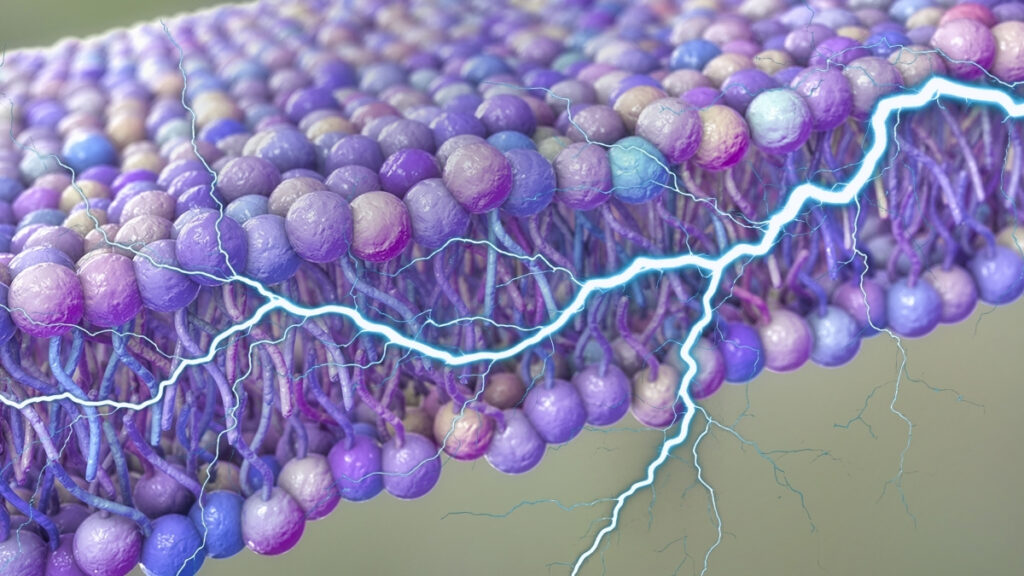
Recent research indicates that the membranes surrounding our cells may serve as a previously unrecognized source of electrical energy. Scientists from the University of Houston and Rutgers University have found that small ripples in these membranes could generate sufficient voltage to assist in transporting materials and facilitating communication within the body.
The study, published in PNAS Nexus, suggests that the fluctuations in the fatty membranes are driven by protein activity and the breakdown of adenosine triphosphate (ATP), which is crucial for energy transport within cells. The researchers propose that these active fluctuations, when coupled with the phenomenon known as flexoelectricity, can produce transmembrane voltages that may power essential biological tasks.
Understanding Membrane Dynamics and Voltage Generation
The concept of flexoelectricity refers to the generation of voltage when strain is applied to a material. Cell membranes bend and flex due to random heat fluctuations, which theoretically should cancel out any produced voltage in a state of equilibrium. However, the researchers argue that cells are not static; they constantly engage in dynamic processes that maintain life.
Through detailed calculations, the scientists determined that flexoelectricity could create an electrical difference across cell membranes of up to 90 millivolts. This voltage is significant enough to trigger neuron activity and may facilitate the movement of ions—charged atoms that play a vital role in electrical signaling within the body. The timing of these charges, emerging on a millisecond scale, aligns well with the rapid signals moving through nerve cells.
The implications of this discovery extend beyond individual cells. The researchers posit that these membrane fluctuations could coordinate across groups of cells, leading to larger-scale biological effects. This understanding may pave the way for further studies to explore how these mechanisms operate within living organisms.
Potential Applications and Future Research Directions
The findings also raise intriguing possibilities for applications outside of biological systems. The researchers suggest that the principles of electricity generation observed in cell membranes could inform the design of artificial intelligence networks and synthetic materials inspired by nature.
In their paper, the research team notes, “Investigating electromechanical dynamics in neuron networks may bridge molecular flexoelectricity and complex information processing, with implications for both understanding brain function and discovering bio-inspired computational materials.”
Future research will aim to validate these findings within living systems, potentially leading to advancements in our understanding of cellular processes and the development of new technologies that harness the principles of biological electricity generation. This study marks a significant step in exploring the intricate connections between bioelectricity and cellular functionality.