



Recent simulations conducted by a team of researchers from the University of Oregon, University of Pennsylvania, and Syracuse University have provided new insights into the concept of an “ideal glass,” a state of matter that has puzzled scientists for decades. Their findings, published on March 1, 2026, in the journal Physical Review Letters, suggest that this elusive material could be synthesized without the conventional need for cooling.
Exploring the Concept of Ideal Glass
The glass we encounter in everyday life, including window panes and smartphone screens, is classified as a disordered solid. Unlike traditional solids, which have a defined structure, these glasses consist of particles arranged randomly, similar to the arrangement in liquids. The notion of an ideal glass, proposed by chemist Walter Kauzmann nearly a century ago, describes a hypothetical material where particles are randomly arranged yet fill space so efficiently that only one arrangement is possible.
Kauzmann’s theories led to a significant exploration of this concept in physics. He argued that reaching an ideal glass state results in a paradox. The system would exhibit properties of both an amorphous liquid and an ordered crystal, leading to the same entropy in both states. This paradox initially led to skepticism about the existence of such a fully equilibrated glass.
However, in the latest study, senior author Eric Corwin and his team propose a solution to this long-standing dilemma. “We believe we have resolved the paradox by demonstrating that an ideal glass is achievable through methods other than waiting for extended periods,” Corwin explained. Their work indicates that while conventional cooling processes may not lead to an ideal glass, alternative techniques can successfully create this unique state.
Innovative Simulations and Findings
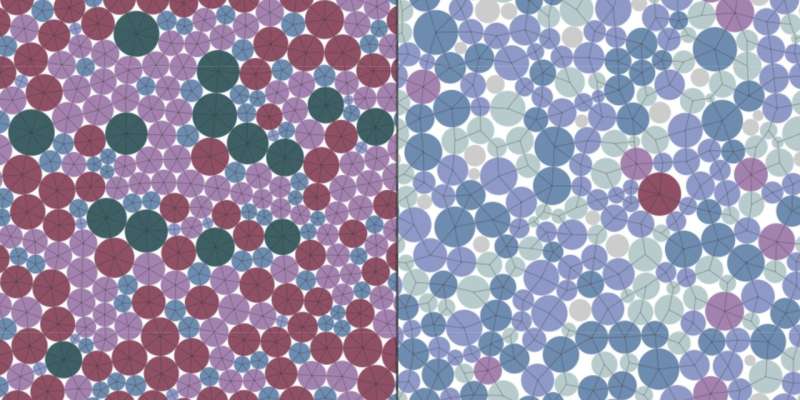
The researchers utilized advanced simulations to examine two-dimensional systems of tightly packed soft particles. By manipulating various parameters, including the size of the particles, they were able to create conditions conducive to forming an ideal glass. “This approach allowed us to achieve mechanical stability in a way that traditional methods could not,” Corwin noted.
In their simulations, the team found that the ideal glass exhibited mechanical properties nearly identical to those of its crystalline counterparts. This suggests that the defining characteristic of the ideal glass is its entropy rather than its spatial ordering. “It’s fascinating that we can separate these two concepts, which were previously thought to be inseparable,” Corwin remarked.
The simulations revealed that the ideal glass forms a structure known as “triangulated packing,” where particles touch each other without gaps, resulting in maximum density. This configuration is achieved using a system where an average of six contacts per particle is maintained, a number that reflects the maximum average contact in two-dimensional systems.
As the research team continues to explore the properties of these ideal configurations, they aim to extend their findings into three-dimensional systems. “The implications of our work might reveal new avenues for understanding how glasses transition between states,” Corwin added. “Our next steps will focus on measuring entropy as a function of pressure to distinguish the ideal glass from conventional varieties.”
This groundbreaking research not only contributes to the understanding of ideal glass but also opens up possibilities for new materials and applications in technology and engineering. By redefining the pathways to achieving equilibrated glass states, the team is paving the way for future innovations in material science.
The study has already inspired further investigations, with several teams adapting the simulated systems for their own research. As the quest to unravel the mysteries of the ideal glass progresses, the findings from Corwin and his colleagues mark a significant step forward in understanding this complex physical phenomenon.