Deep underground at SNOLAB in Canada, scientists have made a groundbreaking discovery: they have observed solar neutrinos facilitating the transformation of carbon-13 into nitrogen-13. This marks the first time such a rare reaction has been directly detected, highlighting the significant role these elusive particles play in reshaping matter far beneath the Earth’s surface.
Christine Kraus, a physicist at SNOLAB, explained, “This discovery uses the natural abundance of carbon-13 within the experiment’s liquid scintillator to measure a specific, rare interaction.” She noted that this finding represents the lowest energy observation of neutrino interactions with carbon-13 nuclei to date and provides the first direct cross-section measurement for this nuclear reaction leading to nitrogen-13.
Neutrinos are among the most abundant particles in the universe, produced during energetic events like supernova explosions and stellar fusion. They are characterized by their lack of electric charge and nearly negligible mass, which allows them to pass through matter almost undetected. Hundreds of billions of neutrinos stream through the human body every second, earning them the nickname “ghost particles.”
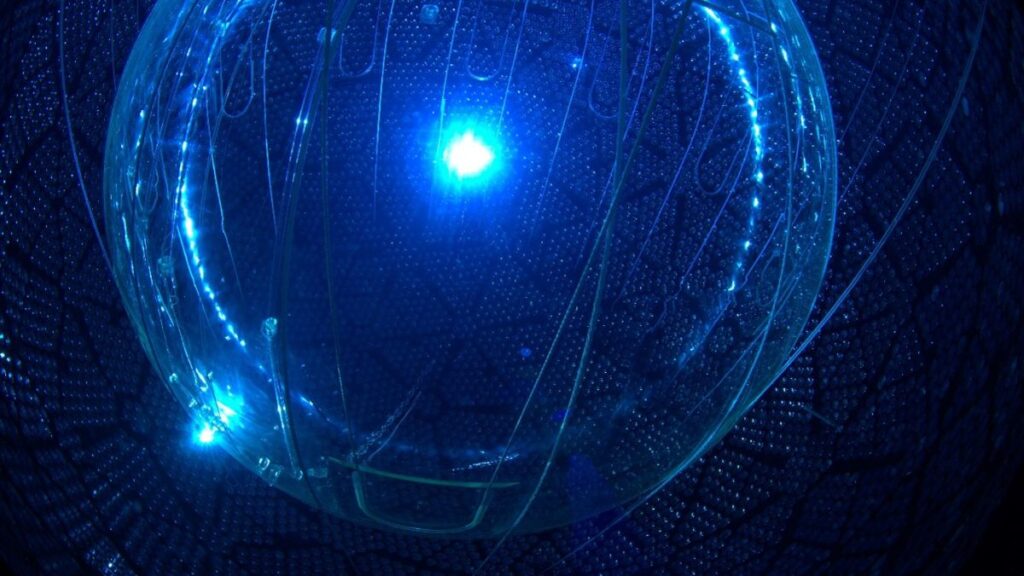
Despite their abundance, detecting neutrinos is challenging due to cosmic rays and background radiation obscuring their faint signals at the Earth’s surface. To address this, neutrino detectors are often situated deep underground, where the Earth’s crust shields them from interference. Within SNOLAB’s 2-kilometer (1.24-mile) depth, the SNO+ detector captures these elusive interactions.
Under the leadership of Gulliver Milton from the University of Oxford, the research team analyzed data collected between May 4, 2022, and June 29, 2023. They searched for a specific signal indicating neutrino interactions with carbon-13 within the scintillator fluid. When a solar electron neutrino strikes a carbon-13 nucleus, it triggers a reaction that produces an electron and transforms the nucleus into nitrogen-13.
The nitrogen-13 isotope, which is radioactive with a half-life of just 10 minutes, subsequently decays, emitting a positron. Researchers identified a characteristic two-step flash, known as a delayed coincidence, where they observed an electron followed by a positron approximately 10 minutes later. From their analysis of 231 days of observation data, they identified 60 candidate events, estimating around 5.6 neutrino-driven carbon-nitrogen transmutations. This closely aligns with their expected count of 4.7 events.
Milton remarked, “Capturing this interaction is an extraordinary achievement. Despite the rarity of the carbon isotope, we were able to observe its interaction with neutrinos, which were born in the Sun’s core and travelled vast distances to reach our detector.”
The implications of this discovery are substantial. It not only confirms theoretical predictions but also provides a new measurement of the probability for this specific low-energy neutrino-carbon interaction. This sets a benchmark for future studies in nuclear physics.
The research team emphasized that solar neutrinos have been a subject of fascination for many years. The earlier experiments conducted by their predecessors, known as SNO, contributed to the 2015 Nobel Prize in Physics. Physicist Steven Biller from the University of Oxford stated, “It is remarkable that our understanding of neutrinos from the Sun has advanced so much that we can now use them for the first time as a ‘test beam’ to study other kinds of rare atomic reactions.”
This important research has been published in the journal Physical Review Letters, marking a significant milestone in the study of neutrinos and their interactions.