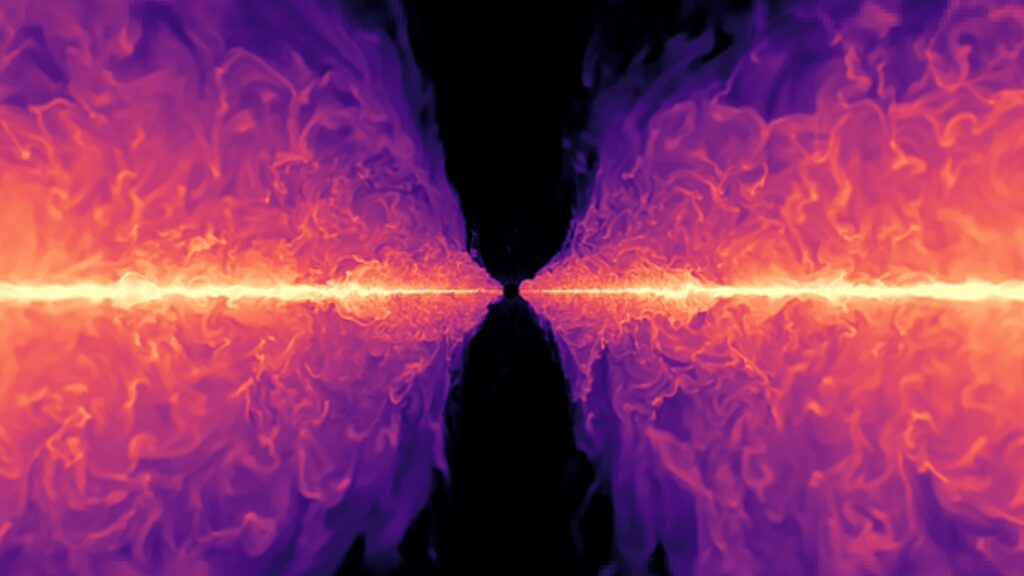
A team of researchers from the Flatiron Institute in the United States has made significant strides in understanding the chaotic environments surrounding black holes. Their latest study provides the most comprehensive simulations to date, revealing how stellar-mass black holes consume and emit matter at varying rates.
The research challenges previous models that relied on oversimplifications, which often hindered accurate predictions. By employing two advanced supercomputers, the team was able to integrate survey observations of black hole accretion flows with detailed measurements of their spin and magnetic fields. This innovative approach allowed them to develop a model that comprehensively describes the behavior of gas, light, and magnetism around black holes comparable in size to our Sun.
“This is the first time we’ve been able to see what happens when the most important physical processes in black hole accretion are included accurately,” stated Lizhong Zhang, an astrophysicist at the Flatiron Institute. The study emphasizes that the dynamics of these systems are highly nonlinear, meaning that any oversimplified assumptions can significantly alter outcomes.
New Insights into Black Hole Behavior
The simulations align with existing observations of various black hole systems. While astronomers have made progress in capturing detailed images of supermassive black holes, understanding the emissions from smaller black holes remains a challenge. The researchers demonstrated that black holes can accumulate dense accretion disks capable of absorbing substantial radiation, which is eventually released through energetic winds and jets.
Their findings also highlighted how a narrow funnel forms around a black hole, facilitating the rapid intake of material and generating a beam of radiation observable from specific angles. Additionally, the configuration of the surrounding magnetic field significantly influences the black hole’s activity, directing gas flows towards its event horizon and enabling the emission of winds and jets.
“Ours is the only algorithm that exists at the moment that provides a solution by treating radiation as it really is in general relativity,” Zhang added. The study incorporates Einstein’s general theory of relativity, which explains how mass distorts space and time, alongside comprehensive models that account for plasma gas, magnetic fields, and light-matter interactions.
Future Applications of the Research
Looking ahead, the researchers aim to explore whether their simulations can also apply to other types of black holes, including the Sagittarius A* supermassive black hole at the center of the Milky Way. They propose that their findings could help clarify the mystery surrounding recently discovered “little red dots,” which emit less X-ray radiation than anticipated.
“While our models use opacities appropriate for stellar-mass black holes, it is likely that many general features of our results will also apply to accretion onto supermassive black holes as well,” the researchers noted.
The study has been published in the Astrophysical Journal, contributing important insights into the complex and dynamic world of black holes and their interactions with surrounding matter. As researchers continue to refine their models, our understanding of these enigmatic celestial objects will undoubtedly deepen, shedding light on some of the universe’s most profound mysteries.