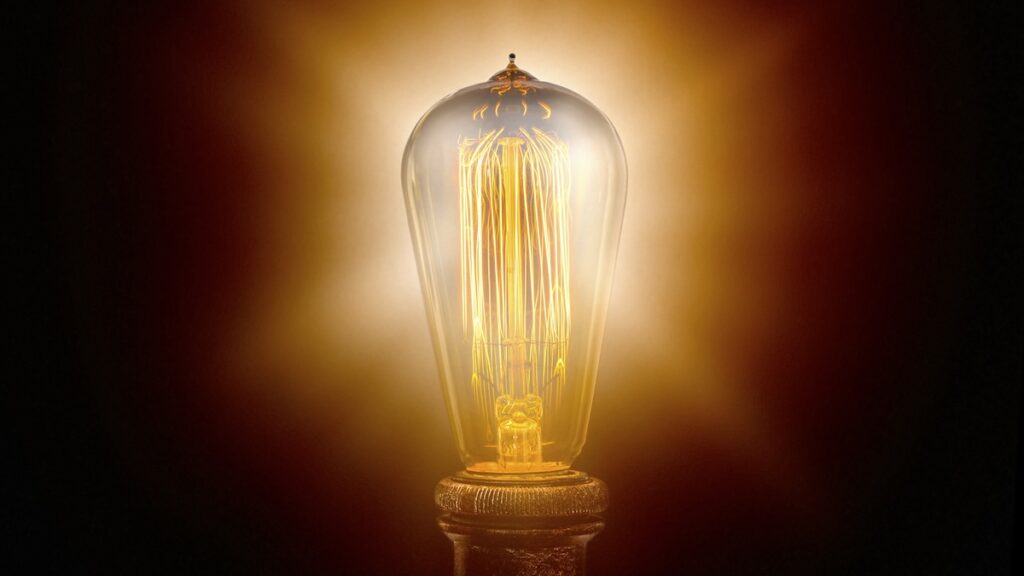
Inventor Thomas Edison may have unintentionally produced graphene, a highly acclaimed material, during his experiments with light bulbs in 1879. Researchers at Rice University suggest that Edison’s work with carbon filaments could have led to the creation of this remarkable substance, which was formally isolated only 125 years later. Graphene, known for its strength, lightweight nature, and unique electrical properties, has become a focal point in modern materials science.
Graphene is a single layer of carbon atoms arranged in a two-dimensional lattice. This deceptively simple structure enables it to exhibit extraordinary characteristics, including the potential to function as a superconductor and to support exotic quantum states. The theoretical groundwork for graphene was laid by Canadian physicist Philip Wallace in 1947, while its isolation was achieved by physicists Andre Geim and Konstantin Novoselov in 2004. Their breakthrough earned them the 2010 Nobel Prize in Physics.
The intriguing possibility that Edison may have created graphene was discovered by accident during a separate investigation. To explore the production of graphene, researchers employed a method called flash Joule heating, which involves applying intense heat—over 2,000 °C (or 3,632 °F)—to carbon-based materials. Lucas Eddy, a materials scientist at Rice University, recalled that early light bulbs often utilized carbon-based filaments. This prompted the team to examine whether Edison’s light bulbs could have yielded graphene.
To test this hypothesis, the researchers sourced replicas of Edison-style light bulbs featuring carbon-rich bamboo filaments. They connected these bulbs to a 110-volt DC power source, activating them in short bursts of 20 seconds. Upon examining the filaments under a microscope, they observed a noticeable color change from gray to silver. Further analysis through spectroscopy confirmed that portions of the filament had indeed transformed into graphene.
Despite this finding, the graphene produced would have been short-lived. If it were not removed after brief use, it would revert to ordinary graphite, a common form of carbon. Even if Edison had recognized the significance of his creation, graphene likely would not have been applicable in his time.
The implications of this discovery extend beyond mere historical curiosity. James Tour, a chemist at Rice University, emphasized the value of revisiting historical experiments through contemporary methodologies. He stated, “Finding that he could have produced graphene inspires curiosity about what other information lies buried in historical experiments. What questions would our scientific forefathers ask if they could join us in the lab today? What questions can we answer when we revisit their work through a modern lens?”
This research has been published in the journal ACS Nano, adding a new chapter to the ongoing narrative of scientific discovery and innovation. The possibility that Edison, a pioneering inventor, played a part in the development of a material that has garnered significant attention today invites further exploration into the intersections of history and modern science.