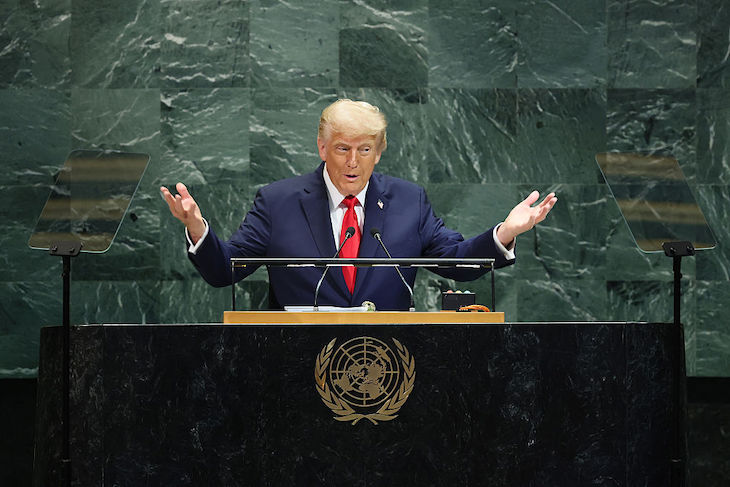
NEW YORK, NEW YORK - SEPTEMBER 23: U.S. President Donald Trump speaks during the United Nations General Assembly (UNGA) at the United Nations headquarters on September 23, 2025 in New York City. World leaders convened for the 80th Session of UNGA, with this year’s theme for the annual global meeting being “Better together: 80 years and more for peace, development and human rights.” (Photo by Michael M. Santiago/Getty Images)
The global landscape is undergoing a significant transformation, resembling the turmoil of the 19th and early 20th centuries more than the stability experienced during the Cold War. This shift, articulated by journalist Gerard Baker in a recent article for The Times of London, highlights a decline in the “near perfect combination of freedom, peace, and prosperity” that many in the West have enjoyed since the mid-20th century. Baker expresses concern that these times are fading, as geopolitical dynamics become increasingly unpredictable and domestic freedoms face new restrictions.
How do we navigate this complex geoeconomic world today, particularly when comparing it to the Cold War era characterized by the Soviet Union’s nuclear threat? Understanding the origins and developments of the post-World War II order provides context for this inquiry.
Post-World War II Settlement
Following the devastation of World War II, the globe split into two main military and economic blocs: the Western bloc led by the United States, which included NATO allies, Japan, Australia, and New Zealand, and the Eastern bloc dominated by the Soviet Union and its allies. The Western bloc fostered market economies with significant government involvement in national development and defense, supported by preferential trade arrangements from the US. This collaboration spurred economic recovery in war-torn Europe and Japan, leading to unprecedented growth.
In contrast, the Eastern bloc’s totalitarian regimes limited global economic interaction, leading to confined conflicts through proxy wars in regions such as Indochina and Central America. The balance of nuclear weapons maintained a fragile peace, while institutions like the World Trade Organization emerged to foster a stable global economy.
The dissolution of the Soviet Union in the early 1990s marked a pivotal point in global relations. As the Soviet system collapsed, China initiated reforms to integrate with Western economies, resulting in an era dominated by economic globalization. This transition created an interdependent global economy but also established new vulnerabilities.
The Era of Economic Globalization
The fall of Soviet communism in 1989 opened doors for China to adopt market-oriented policies, leading to an influx of Western investment and technology. This era of globalization, as termed by journalist Thomas Friedman in his book, “The World is Flat,” suggested that interconnected economies would foster equality and collaboration.
However, this integration came with unintended consequences. China leveraged state support to rapidly expand its economy, rising from the eleventh to the second-largest globally between 1990 and 2025. Simultaneously, the Belt and Road Initiative allowed China to extend its influence across Eurasia, Africa, and Latin America, challenging Western dominance.
As both Beijing and Moscow expanded their military capabilities, tensions escalated. China’s aggressive posture in the South China Sea and Russia’s invasion of Ukraine in 2022 underscored the fragility of this new order and the shift toward a more confrontational global landscape.
The term “weaponised interdependence” encapsulates this new dynamic, as described by scholars Henry Farrell and Abraham Newman. Their work reveals how globalization has created a landscape of strategic vulnerabilities, where countries can leverage economic dependencies as tools of power.
The authors outline three critical elements of the interconnected global economy, which originated from US-centric systems. The US has integrated global communications through the internet, established the US dollar as the primary currency for international transactions via the SWIFT network, and dominated the design and production of advanced semiconductors.
As Farrell and Newman point out, these systems can serve as “weaponised choke points” that governments may exploit for strategic advantage. For instance, in 2025, China threatened to restrict exports of rare earth materials, crucial for technology and defense industries, to the US and EU. This geopolitical maneuvering forced the US to negotiate compromises, highlighting the complexities of modern international relations.
Challenges and Future Directions
The landscape has shifted significantly since the Cold War, with the emergence of new powers and the rise of alternative alliances such as the BRICS nations—Brazil, Russia, India, China, and South Africa. These countries have discussed developing alternative global structures to circumvent US-centric systems, including a rival to the SWIFT payment system.
Despite the potential of the BRICS nations, trust issues hinder the viability of alternatives. The international payment system relies heavily on transparency and reliability, which are less assured in countries like Russia and China.
The European Union stands at a crossroads, possessing the potential to be a geoeconomic superpower. However, its fragmented response to external threats, particularly from China, limits its effectiveness in securing its economic interests. European companies often seek access to the Chinese market at the cost of broader security measures, complicating the EU’s ability to respond cohesively.
The current environment necessitates a strategic reassessment by the United States. As highlighted by Farrell and Newman, the US possesses significant advantages in critical choke points but must navigate an increasingly complex terrain with multiple global players.
Australia, in particular, faces vulnerabilities in this geoeconomic landscape. The nation has become reliant on mineral and energy exports while struggling to revitalize its manufacturing sector. Recent tensions with China, following Australia’s support for an inquiry into the origins of COVID-19, exemplify the risks of economic coercion.
To effectively navigate this evolving landscape, Australia must prioritize rebuilding its manufacturing base and focusing on strategic industries to mitigate the risks of dependency.
In conclusion, the geoeconomic order is shifting, with new powers asserting influence and strategic vulnerabilities emerging. Understanding these dynamics is crucial for nations seeking to secure their interests and navigate the complexities of a rapidly changing global landscape.