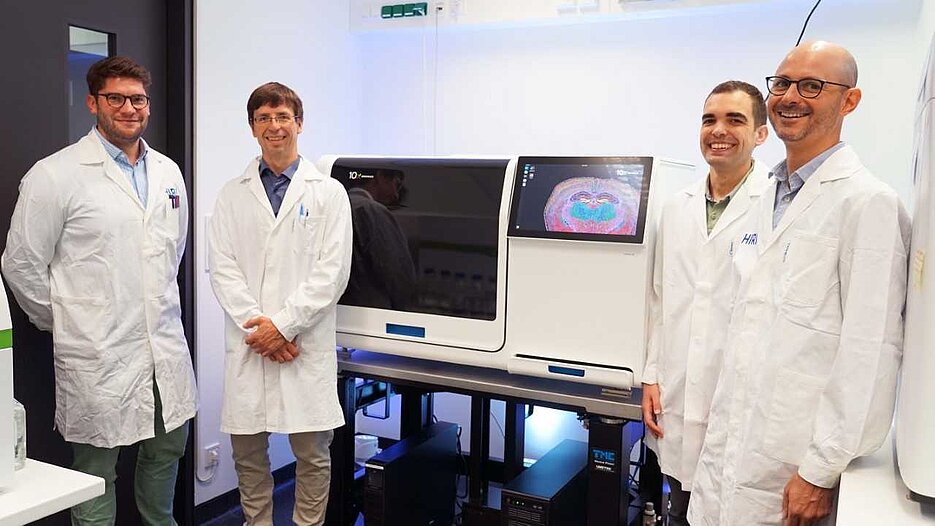
Researchers at the *Julius-Maximilians-Universität (JMU)* and the *Helmholtz Institute Würzburg (HIRI)* have developed a groundbreaking technology that enhances the understanding of complex disease processes. The newly introduced “in situ RNA imaging analyzer” allows scientists to visualize the spatial distribution of RNA molecules within individual cells and surrounding tissues, marking a significant advance in single-cell analysis.
For years, the *Single-Cell Center (SCC)* in Würzburg has focused on the intricate study of individual cells. This state-of-the-art facility has built expertise in both experimental and computational methods for single-cell analysis. The introduction of the in situ RNA imaging analyzer transforms this research by providing insights that were previously unavailable. As Professor *Dominic Grün*, Chair of Computational Biology of Spatial Biomedical Systems, states, “The In-Situ RNA Imaging Analyzer is a powerful tool for us. It allows us to visualize the spatial distribution of RNA molecules in cells and tissues, enabling us to understand biological processes much more accurately.”
Enhancing Disease Understanding
The implications of this technology are profound. By examining the bone marrow of patients with *multiple myeloma*, a type of bone marrow cancer, researchers can identify which cells contribute to the disease and how they interact at the molecular level. These interactions are crucial in determining disease progression and tissue recovery following treatment.
In addition to cancer research, the technology has potential applications in cardiovascular health. Following a heart attack, scar tissue formation can impair the heart’s pumping ability, leading to heart failure. Understanding how different cells collaborate in heart tissue repair could pave the way for improved therapeutic strategies.
According to *Antoine-Emmanuel Saliba*, spokesperson for the SCC and research group leader at HIRI, the investment in this technology positions Würzburg as a leader in single-cell research. “The Single-Cell Center provides state-of-the-art methods and expertise to efficiently evaluate data, creating ideal conditions for long-term research growth,” Saliba noted.
A New Era of Data Analysis
The in situ RNA imaging analyzer generates vast amounts of data, necessitating advanced analysis techniques. Machine learning and artificial intelligence play key roles in interpreting the information collected from tissue samples. Grün and Saliba’s teams are actively developing specialized algorithms to streamline this process, ensuring that researchers can draw meaningful conclusions from the data.
This innovative approach not only enhances the understanding of diseases such as cancer and autoimmune disorders but also supports advancements in infection biology. The *Helmholtz Institute for RNA-Based Infection Research (HIRI)* is the first of its kind to merge RNA research with infection studies. HIRI aims to develop innovative diagnostic and therapeutic strategies grounded in its robust research findings.
The *Single-Cell Center Würzburg* is a collaborative effort involving multiple institutions, including the Faculty of Medicine at *JMU*, the *University Hospital Würzburg (UKW)*, and the *Max Planck Research Group* at the *Würzburg Institute of Systems Immunology (WüSI)*. This multidisciplinary approach fosters an environment conducive to significant breakthroughs in biomedical research.
In summary, the introduction of the in situ RNA imaging analyzer represents a pivotal moment for medical research in Würzburg. By providing deeper insights into cellular processes, this technology promises to enhance the understanding and treatment of various diseases, ultimately improving patient outcomes.