


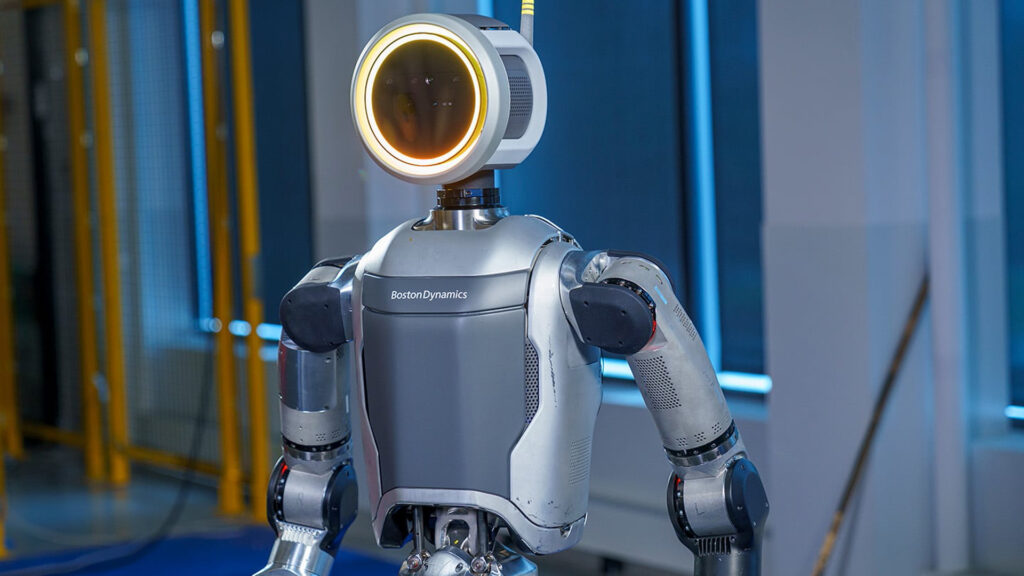
Boston Dynamics has officially announced that its highly anticipated humanoid robot, Atlas, is set to enter factory environments beginning in 2028. The unveiling took place on January 5, 2026, during the Consumer Electronics Show (CES) in Las Vegas, where the company showcased the product alongside its partner, Hyundai Motors. This milestone marks a significant development in robotics, following over three decades of innovation from Boston Dynamics.
The latest version of Atlas, now an all-electric model, aims to work collaboratively with the company’s existing Spot quadruped robot in manufacturing settings. For the first time, Boston Dynamics provided a public demonstration of Atlas’s capabilities, which had previously been kept under wraps. The demonstration highlighted a range of impressive skills, including parkour, gymnastics, and simulated factory tasks, showcasing the robot’s agility and versatility.
Atlas is engineered with remarkable features, including 56 degrees of freedom, self-battery replacement, and the ability to lift weights up to 110 pounds. Equipped with human-like hands that feature tactile sensors, the robot can be trained for new tasks in less than a day, significantly enhancing its functionality in diverse environments.
Gradual Integration into Manufacturing
Despite its advanced capabilities, Atlas will not immediately assume a role on factory floors. The robot is scheduled to start its duties at the Hyundai Motor Group Metaplant America located in Savannah, Georgia. Initially, Atlas will focus on parts sequencing tasks, with plans to expand its role to component assembly by 2030. According to Boston Dynamics, the robot will take on responsibilities involving repetitive motions, heavy loads, and other complex operations, with the ultimate goal of creating “safer work environments for factory employees.”
Boston Dynamics credits much of its progress to a partnership with Nvidia, which has provided AI infrastructure and models that facilitate physical robotics training. This collaboration has been in effect since early 2025, enabling Boston Dynamics to enhance Atlas’s training capabilities.
In a further strategic move, Boston Dynamics has also partnered with Google’s DeepMind to work on developing advanced robot AI foundation models. This partnership is expected to accelerate Atlas’s training and skill development throughout 2026.
Cost Considerations and Market Position
While Boston Dynamics has not disclosed specific pricing for the Atlas humanoid robot, estimates suggest it could cost at least double, if not triple, the price of the Spot robot, which is typically priced around $75,000. This positions Atlas competitively within the market, particularly against emerging humanoid robots from companies like 1X, Figure AI, and Tesla, all of which are eyeing deployment in various sectors, including homes.
As Boston Dynamics prepares to launch Atlas into the factory environment, the focus remains on enhancing productivity without displacing human workers. The integration of such advanced robotics signals a transformative era for manufacturing, emphasizing efficiency and safety in the workplace.
With the official introduction of Atlas, Boston Dynamics continues to solidify its reputation as a leader in robotics, paving the way for more innovations in the coming years.