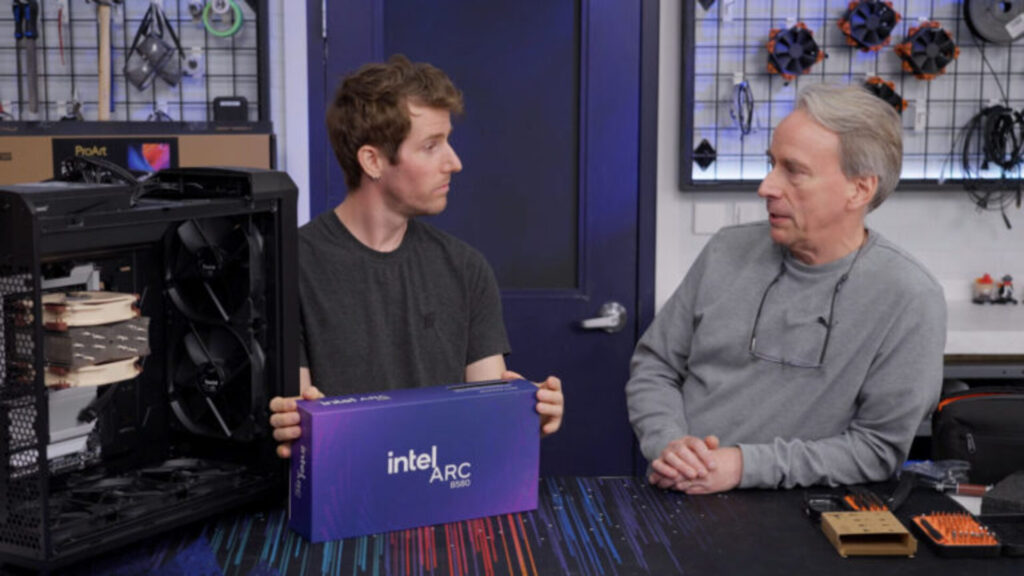
Linus Torvalds, the creator of the Linux kernel, recently shared his vision for the perfect Linux PC during a live build session with Linus Sebastian from Linus Tech Tips. The nearly one-hour video not only showcased the assembly of this custom machine but also highlighted Torvalds’s specific hardware preferences, which reflect his priorities as a professional developer.
Among the key components of Torvalds’s ideal setup is the AMD Threadripper CPU, known for its exceptional multi-core performance. This choice allows for efficient parallel processing, making it particularly suitable for compiling large codebases and running multiple virtual machines. The build also features Error-Correcting Code (ECC) memory, which helps detect and correct data errors, ensuring reliability in critical development tasks.
The selection of the Intel Arc 8580 GPU raised eyebrows within the Linux community, as Torvalds is not known for gaming. Traditionally, Radeon graphics cards have been favored for their open-source drivers, while Nvidia has encountered criticism for compatibility issues. Despite this, Torvalds specifically opted for the Arc 8580, a decision that underscores his focus on hardware compatibility with mainline kernels and his personal workflow needs. Linus Sebastian remarked that a Radeon GPU would have been the “obvious Linux choice,” illustrating the unconventional nature of Torvalds’s decision.
Emphasis on Reliability and Stability
Torvalds’s preferences extend beyond raw performance; he clearly values stability and a quiet operating environment. The choice of ECC memory and a low-noise system emphasizes his desire for a setup that does not require constant attention, which is essential for developers who need to focus on their work without distractions. This combination makes the device ideal for professional Linux tasks, such as testing different Linux distributions efficiently.
The Threadripper’s substantial core and thread count provides significant advantages, enabling developers to compile large projects with ease. While these specifications may appeal to programming professionals, they also suggest a broader application for anyone in need of reliable computing power, extending even to smaller systems like mini PCs that support ECC memory and kernel compatibility.
Challenges of Accessibility
Despite the impressive specifications of Torvalds’s “perfect Linux PC,” it is unlikely to become a mainstream option for enthusiasts. The combination of high-end Threadripper CPUs, ECC memory, and the Intel Arc 8580 GPU results in a configuration that is both costly and specialized. While the build serves as an ideal setup for development and Linux compatibility, few users are likely to invest in such a tailored machine.
This insight into Torvalds’s hardware choices reveals the priorities of a professional developer: reliability, kernel compatibility, and efficient multi-core performance. These factors take precedence over gaming capabilities, highlighting a focus on long-term productivity rather than consumer trends in technology.
As this discussion continues to resonate within the tech community, it serves as a reminder of the distinct needs of developers and the types of systems that can best support their work. While many may admire Torvalds’s preferences, the reality of the market suggests that only a niche audience will pursue such an advanced configuration for their Linux computing needs.