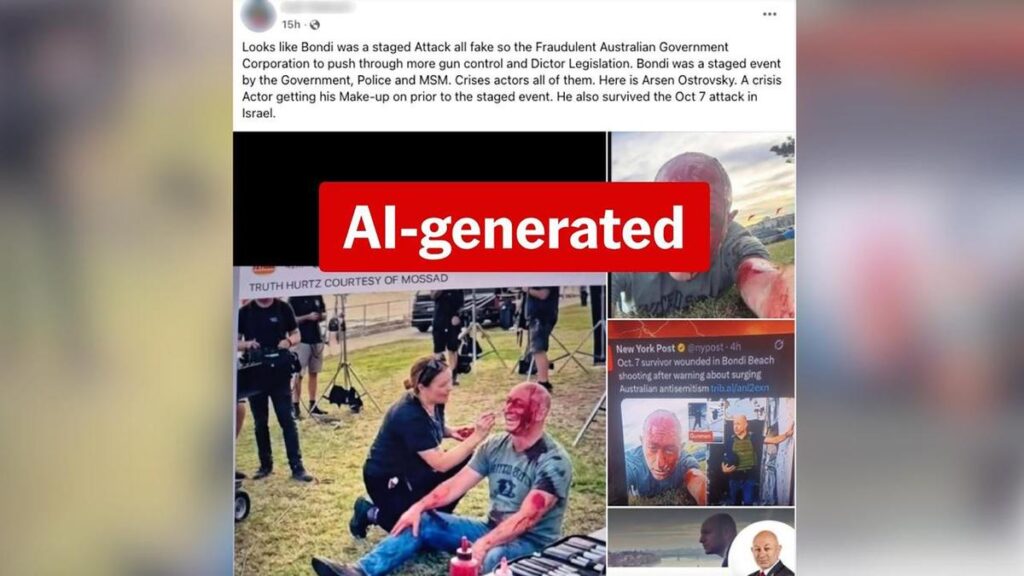
The tragic shooting at Bondi Beach on December 14, 2023, which resulted in the deaths of 15 people during a Hanukkah celebration, has sparked a wave of misinformation across social media. Allegations regarding fake heroes and actors, alongside manipulated videos, have emerged, complicating the community’s grief and raising concerns about the role of artificial intelligence in spreading false narratives.
Shortly after the attack, reports surfaced claiming that a 43-year-old IT professional named Edward Crabtree had intervened during the shooting. This individual was later revealed to be Ahmed Al Ahmed, as confirmed by the Australian Associated Press’ FactCheck service, which identified at least a dozen instances of misinformation proliferating online. The false reports originated from a fabricated article on a website called The Daily, attributed to a fictitious journalist named Rebecca Chen. Investigations revealed that the website was registered on the same day as the attack from an Icelandic address.
Fake videos have also contributed to the chaos. One clip falsely depicted Australian Prime Minister Anthony Albanese announcing the cancellation of visas for all Pakistani nationals in the wake of the attack. Another video misrepresented New South Wales Premier Chris Minns as confirming details regarding one of the shooters, claiming he was an Indian national. Both videos have been debunked by AAP’s FactCheck researchers.
In addition to these misleading narratives, AI-generated images have gone viral. One particularly notable image falsely portrayed Arsen Ostrovsky, who was interviewed after the incident, as a paid “crisis actor” receiving makeup on a film set. This mock image suggested that the tragedy was staged, further complicating the public’s understanding of the event. Ostrovsky faced additional misinformation, with altered photos alleging that his injuries were fabricated.
The spread of misinformation has extended beyond social media posts, as doctored images surfaced claiming to show Naveed Akram meeting with Indian Defence Attaché Captain Chandra Kant Kothari.
Experts are increasingly alarmed by the rapid spread of misinformation, particularly in the wake of tragedies. Atie Kia, an AI expert from Swinburne University, emphasized that social media platforms, coupled with readily available AI tools, create an environment where deepfakes and false narratives can thrive. “After a tragedy, people look for answers, and that creates the perfect space for AI-generated images and false stories to spread,” she explained. Kia highlighted the growing sophistication of AI-generated content, making it more challenging to identify fakes.
Despite the availability of accurate information from authorities, discussions about the nationalities of the gunmen have continued to circulate online. The Australian government confirmed that one of the attackers was born in Australia, while Indian police stated that the other originated from Hyderabad.
Kia underscores the importance of individual responsibility in verifying information before sharing it. “People think it takes a professional to create fake videos but it just takes some clicks,” she noted. As misinformation continues to spread, the need for strong verification practices and improved digital literacy becomes ever more critical.