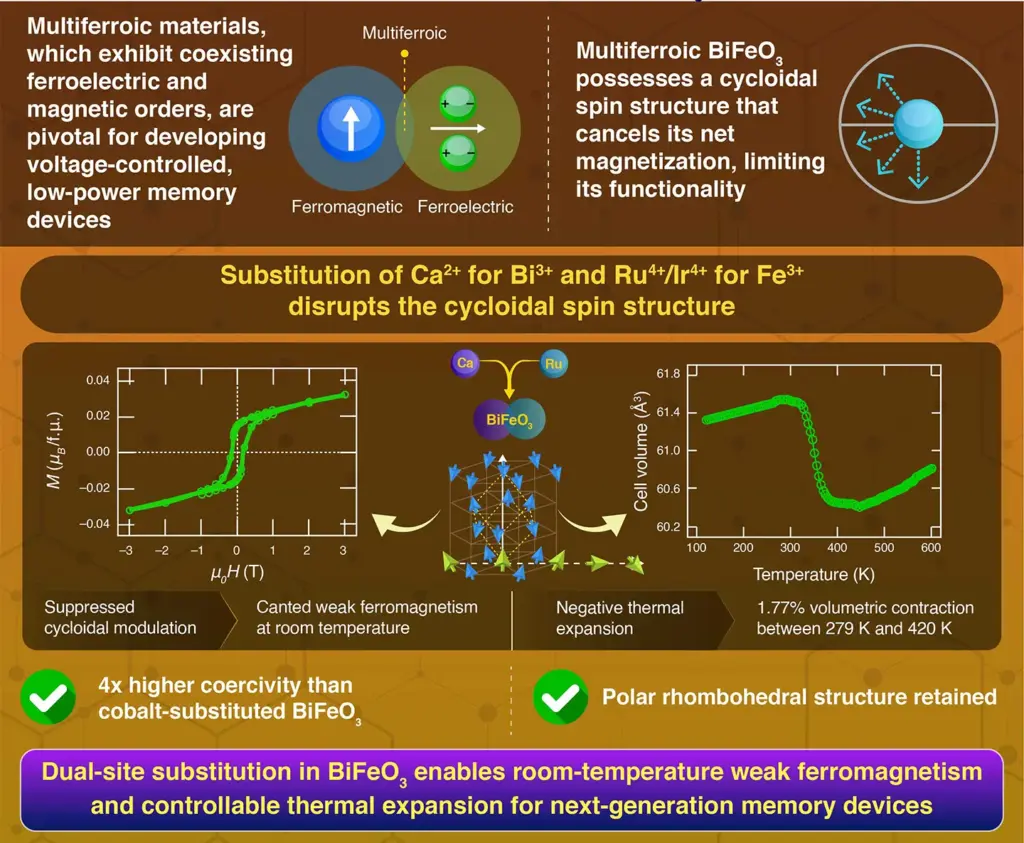
Researchers at the Institute of Science Tokyo have successfully introduced ferromagnetism into bismuth ferrite (BiFeO3), a promising multiferroic material, using a dual-cation substitution method. This breakthrough not only enhances the material’s magnetic properties but also reveals negative thermal expansion, positioning BiFeO3 as a potential candidate for next-generation memory technologies.
Engineering Magnetism and Thermal Expansion
Bismuth ferrite is notable for its combination of ferroelectricity and antiferromagnetism at room temperature. Traditionally, BiFeO3 exhibits a cycloidal spin structure, which cancels out net magnetization, limiting its application in magnetic devices. Previous research suggested that eliminating this cycloidal modulation could yield the weak ferromagnetism necessary for practical use.
Past attempts to disrupt the cycloidal structure included substituting cobalt ions for iron ions, leading to a successful transition to a canted antiferromagnetic arrangement; however, this method left room for further enhancement. The research team, led by Professor Masaki Azuma and including collaborators from various institutions, explored a new approach. They replaced iron ions with heavier transition metals such as ruthenium and iridium, which possess stronger spin-orbit coupling compared to cobalt. Additionally, they substituted some bismuth ions with calcium to maintain charge balance.
This innovative dual substitution resulted in a new set of BiFeO3-based compounds with significantly modified magnetic and thermal expansion properties. The findings were detailed in a publication in the Journal of the American Chemical Society on November 28, 2025.
Key Findings and Applications
The compounds created, such as Bi0.9Ca0.1Fe0.9Ru0.1O3 and Bi0.9Ca0.1Fe0.9Ir0.1O3, exhibited clear ferromagnetic behavior at room temperature. Their spontaneous magnetization levels were comparable to those of cobalt-substituted BiFeO3, but with coercive fields nearly four times higher. This increase in coercivity is critical for ensuring information stability in future multiferroic memory devices.
“We found that simultaneous substitution of ruthenium or iridium for iron and calcium for bismuth suppressed the cycloidal modulation and produced canted weak ferromagnetism at room temperature while still keeping the polar rhombohedral crystal structure,” says Professor Azuma.
Computational analyses indicated that the enhanced magnetism stems from the strong spin-orbit coupling within the ruthenium and iridium ions. This interaction increases the planar single-ion magnetic anisotropy, effectively diminishing the cycloidal modulation that had previously hindered BiFeO3’s magnetic applications.
Furthermore, the team discovered that the dual substitution significantly lowered the temperature at which the material loses its ferroelectric properties. Notably, one compound, Bi0.85Ca0.15Fe0.85Ir0.15O3, demonstrated a volume contraction of 1.77% when heated from 279 K to 420 K (approximately 6 °C to 147 °C). This negative thermal expansion behavior could address challenges posed by thermal expansion in electronic components that incorporate various materials.
These results highlight the potential of carefully engineered combinations of tetravalent and divalent ions in reshaping the spin structure, stabilizing ferromagnetism, and tuning thermal performance. Professor Azuma emphasized that these findings pave the way for designing multifunctional materials that integrate magnetoelectric coupling with thermal expansion control, which could lead to significant advancements in memory technologies and structural applications.
The collaborative efforts of the research team, which included members from the Kanagawa Institute of Industrial Science and Technology, Kyoto University, Nagoya Institute of Technology, and the Japan Synchrotron Radiation Research Institute, underscore the importance of interdisciplinary approaches in scientific advancements.