




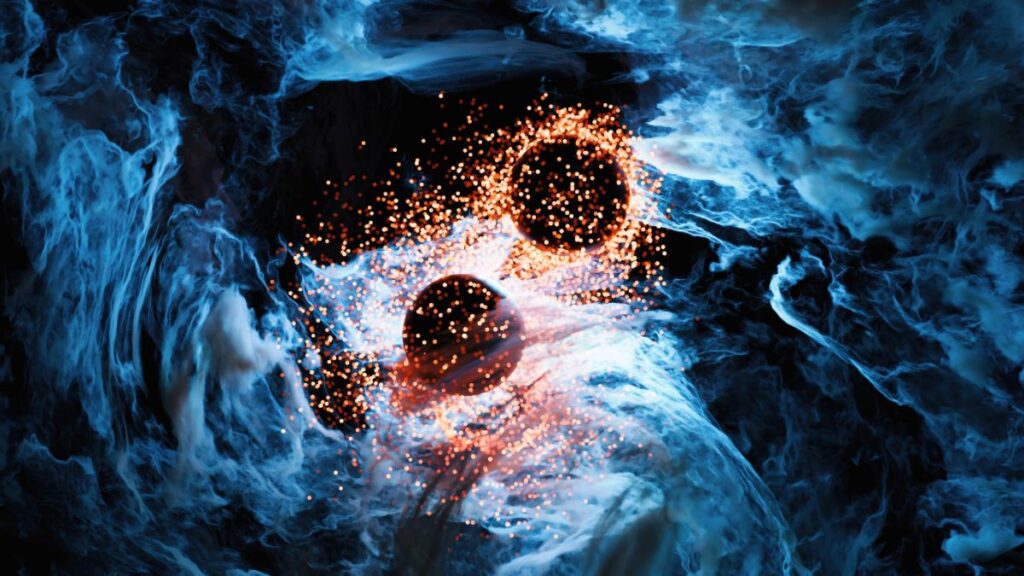
Scientists have made a significant breakthrough in understanding the aftermath of the Big Bang, revealing that the early universe was much like a turbulent soup. This discovery, detailed in a study published in March 2024, sheds light on the conditions present shortly after the universe’s inception, approximately 13.8 billion years ago.
The research, conducted at the European Organization for Nuclear Research (CERN), focused on recreating the conditions of the universe just moments after the Big Bang. Utilizing the Large Hadron Collider, scientists simulated the extreme temperatures and densities that characterized this early phase. During these experiments, researchers observed the formation of quark-gluon plasma, a state of matter thought to have existed in the first microseconds following the Big Bang.
Understanding Quark-Gluon Plasma
Quark-gluon plasma consists of free quarks and gluons, the fundamental building blocks of matter. In the billions of years since the Big Bang, these particles have combined to form protons and neutrons, which in turn make up atoms. The ability to recreate such conditions in a laboratory setting not only enhances our understanding of the universe’s formation but also provides insights into the fundamental laws of physics.
According to lead researcher Dr. Elena Garcia, “This simulation allows us to observe the properties of matter in its most primitive state. By studying the quark-gluon plasma, we can learn more about how the universe evolved and the forces that shaped it.” The findings are expected to influence future research in particle physics and cosmology.
The experiments involved colliding protons at nearly the speed of light, producing extreme temperatures that reach upwards of 4 trillion degrees Celsius. At these temperatures, matter transitions into the quark-gluon plasma state, resembling a soup-like mixture, where traditional structures of matter break down.
Implications for Future Research
This research not only enriches our understanding of the universe’s early moments but also has broader implications for various fields of science. The insights gained from this study could help in understanding the fundamental interactions that govern particle behavior and the evolution of cosmic structures.
Furthermore, the findings may open new avenues for exploring dark matter and dark energy, two of the most enigmatic components of the universe that remain poorly understood. By examining the properties of matter under such extreme conditions, scientists hope to uncover clues that could lead to groundbreaking discoveries in understanding the fabric of the universe.
As this research progresses, it will continue to attract attention from the scientific community and beyond, emphasizing the importance of collaboration and innovation in unraveling the mysteries of our universe. The results from CERN not only deepen our knowledge of cosmic history but also inspire future generations of scientists to explore the unknown.