



Acciona Energia has laid off approximately 30 employees from its construction division, representing about 15 percent of its Australian workforce. This decision comes as the company grapples with planning bottlenecks and rising costs that are hindering investment growth in the renewable energy sector, crucial to the Albanese government‘s energy transition plans.
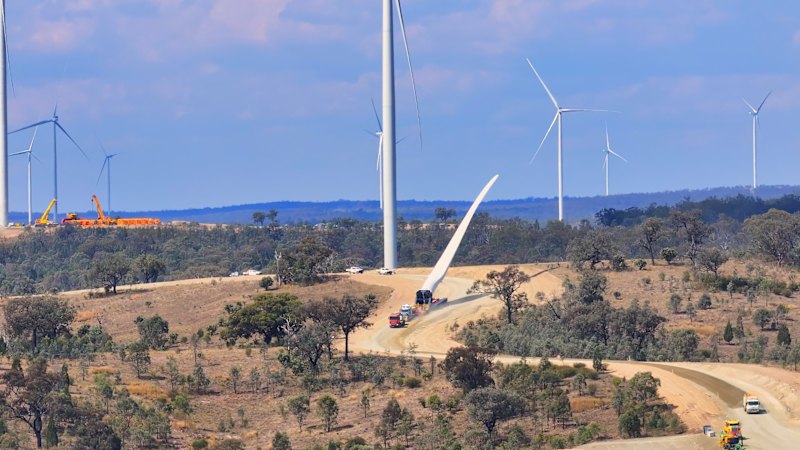
Acciona Energia, the energy arm of the multinational infrastructure firm Acciona, is responsible for several large-scale renewable projects in Australia, including the MacIntyre Wind Farm in south-east Queensland and the Aldoga Solar Farm near Rockhampton. The recent job cuts primarily affect the engineering and construction division, which manages the design and execution of ongoing projects.
Challenges in the Renewable Energy Landscape
Industry insiders, who spoke on the condition of anonymity, indicated that these layoffs signal a potential slowdown in the pipeline of shovel-ready projects. Such projects require meticulous coordination to avoid significant cost increases. Challenges in securing planning approvals, establishing grid connections, and meeting construction timelines have emerged as critical issues for renewable energy developers.
The sluggish investment climate is amplifying pressure on the federal government’s goal to phase out coal power and achieve 82 percent renewable energy generation in Australia’s grid by 2030. According to Richie Merzian, CEO of the Clean Energy Investor Group, there is an urgent need for government action to facilitate the transformation of proposed clean energy projects into reality.
“Project origination, approvals, financing, and construction all need to align, but that requires a level of coordination that we just don’t have right now,” Merzian stated. He emphasized that 2026 is a critical year for initiating construction to meet the 2030 target. However, investor frustration is growing as projects face numerous hurdles.
Government Response and Future Outlook
RenewMap, a market intelligence firm, recently reported that planning bottlenecks for clean energy have been particularly pronounced in New South Wales (NSW), where median approval times have extended to two and a half years. At the federal level, the backlog of renewable projects awaiting environmental approvals has surged to around 140, up from just under 40 in 2023.
Chris Bowen, Minister for Climate Change and Energy, defended the government’s efforts, citing the Capacity Investment Scheme and the Rewiring the Nation fund as vital measures to provide long-term certainty for project financing. He highlighted the 64 gigawatts of power projects in the grid operator’s connections pipeline as evidence of progress.
Bowen remarked, “That is how you deliver cheaper, cleaner, and more reliable energy, not by delaying and denying. After a decade of Coalition chaos and delay, we are delivering the certainty investors need and Australians deserve.”
Nonetheless, Alex Thompson from RenewMap pointed out that governments are struggling to translate the extensive pipeline of projects from concept to construction. He noted, “On paper, we have more than double the capacity under development than the Australian Energy Market Operator (AEMO) says is needed to complete the transition.” The challenge lies not in ambition but in the friction between various stages, particularly in approvals and grid connections, which undermines investor confidence in the timelines for project delivery.