
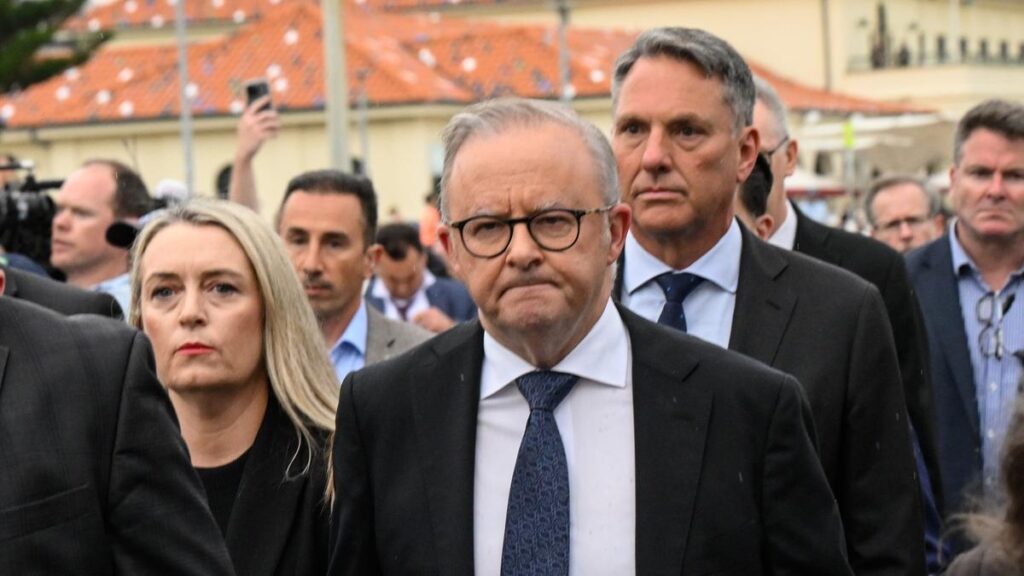
SYDNEY, AUSTRALIA - DECEMBER 21: Australia's Prime Minister Anthony Albanese (C), his wife Jodie Haydon (2nd L), Deputy Prime Minister Richard Marles (2nd R) arrive for a memorial for the victims of the mass shooting that took place last week at Bondi Beach on December 21, 2025 in Sydney, Australia. Life slowly returned to normal at Bondi Beach, with people from all walks of life still paying respects and tributes as raw grief and funerals gave way to commemorations. Police say at least 16 people, including one suspected gunman, were killed and more than 40 others injured when two attackers opened fire near a Hanukkah celebration at the world-famous Bondi Beach, in what authorities have declared a terrorist incident. The government is moving to tighten gun laws across the country. (Photo by Izhar Khan/Getty Images)
UPDATE: Prime Minister Anthony Albanese faced intense backlash at the National Day of Reflection Service on Sunday night, where he was booed and heckled, signaling a critical deterioration in his relationship with the Jewish community. This comes in the wake of a tragic shooting that left 15 people dead during a Hanukkah celebration at Bondi Beach.
During the same event, NSW Premier Chris Minns received a standing ovation, having taken decisive action to respond to the crisis. Minns has vowed to strengthen laws against hate speech and announced the establishment of a state Royal Commission to investigate the circumstances surrounding the attack. His unity and leadership have resonated with the public, contrasting sharply with Albanese’s perceived failure to act swiftly and effectively.
The tension escalated as Albanese initially proposed tightening gun laws, a move met with skepticism and labeled as a diversion by critics. Following this, he announced a review of intelligence agencies, which has drawn further scrutiny. ASIO Director-General Mike Burgess admitted the agency’s inability to foresee the attack, stating, “Tragically, in this case we did not know about the attack before it happened.”
At the Reflection Day ceremony, David Ossip from the NSW Board of Deputies criticized Albanese for not supporting a comprehensive Federal Royal Commission. He stated, “It cannot be disputed that we need a royal commission which goes beyond New South Wales to get to the bottom of how this catastrophe took place.” Albanese has been criticized for not attending funerals of victims, further isolating him from the grieving community.
The stark contrast in reception between Albanese and Minns highlights a growing divide in leadership styles. While Minns has actively engaged with the Jewish community, attending memorials and services, Albanese’s absence has prompted questions about his commitment to addressing the surge in antisemitism across Australia.
Amidst the turmoil, the Prime Minister’s promises to eradicate antisemitism seem increasingly hollow without actionable steps. Critics argue that mere statements are insufficient in the face of such a grave national crisis. The need for a comprehensive inquiry into the recent violence is more urgent than ever.
As the situation develops, all eyes remain on Albanese. Will he heed calls for an inquiry, or will he continue to sidestep the issue? The community demands accountability and action, and the pressure is mounting for the Prime Minister to respond decisively.
This ongoing crisis not only impacts political relationships but also highlights the broader societal implications of rising antisemitism in Australia. With calls for unity and action echoing across the nation, the leadership challenge for Albanese has never been more pressing.
Stay tuned for updates as this situation unfolds.