


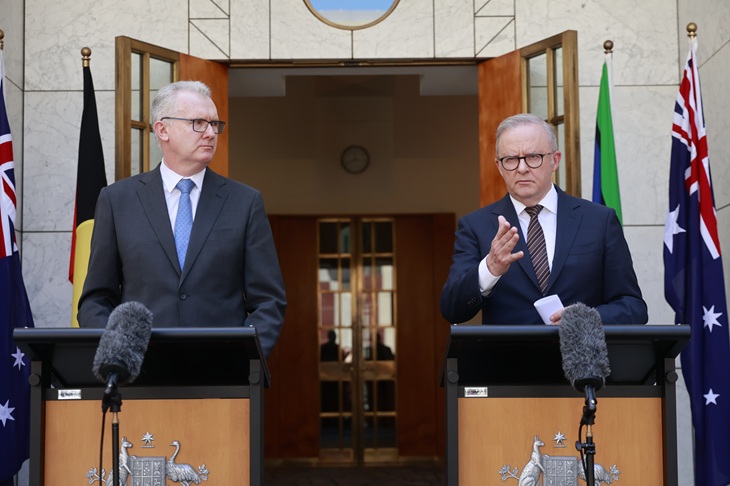
CANBERRA, AUSTRALIA - DECEMBER 19: Minister for Home Affairs Tony Burke (L) and Australian Prime Minister Anthony Albanese (R) speak to the media at Parliament House on December 19, 2025 in Canberra, Australia. Albanese held the press conference as the government comes under pressure over the recent Bondi mass shooting, promising to tighten gun laws across the country. (Photo by Hilary Wardhaugh/Getty Images)
UPDATE: Australia is grappling with a national crisis following the devastating terrorist attack at Bondi Beach on December 14, 2025. Prime Minister Anthony Albanese is under fire for his inadequate response and has announced a limited departmental inquiry, while rejecting widespread calls for a full Royal Commission into this heinous act.
The attack, which left the nation reeling, has sparked outrage over the government’s failure to address the rising tide of antisemitism since the brutal assault by Hamas on Israel on October 7, 2023. Many Australians are questioning how such a horrific event could occur, especially when the warning signs were evident for years.
In an open letter published on January 2, 2026, hundreds of business and community leaders demand “clear answers” and call for practical solutions to restore social cohesion. They argue that the Bondi massacre requires a national response, transcending political lines during these turbulent times.
The Labor government’s narrow inquiry, presented as a means of promoting “unity and social cohesion,” is seen as inadequate and misleading. Critics argue it fails to address the community’s fractured state, highlighting an urgent need for comprehensive investigation and accountability.
Following multiple press conferences, it has become clear that Labor is unwilling to submit to a full Royal Commission, raising questions about their motivations. This resistance has led to speculation regarding Albanese’s leadership, with some ministers conspicuously absent over the holiday period, including Penny Wong and Richard Marles.
Political insiders suggest that the Labor Party’s strategy is rooted in fear of exposing past inactions regarding antisemitism, which could have serious implications for the party’s future. The government is now facing mounting pressure from constituents who feel their safety is at risk.
As the clock ticks down to the next federal election, scheduled no later than May 20, 2028, public sentiment is shifting against the Albanese government. The earliest election date could be as soon as August 7, 2027, and the Prime Minister’s position is more precarious than ever.
Albanese’s once-promising leadership appears diminished, as he struggles to navigate the growing public discontent. The Labor Party’s reluctance to embrace a Royal Commission may ultimately backfire, leaving them vulnerable in the face of increasing demands for accountability.
The stakes are high, and the implications of this inquiry will resonate far beyond the immediate crisis. As Australians await answers and action, the demand for leadership and transparency has never been more urgent.
As the situation develops, the nation watches closely to see if Albanese will shift course or remain steadfast in his current stance, with the potential for significant political repercussions looming on the horizon.