




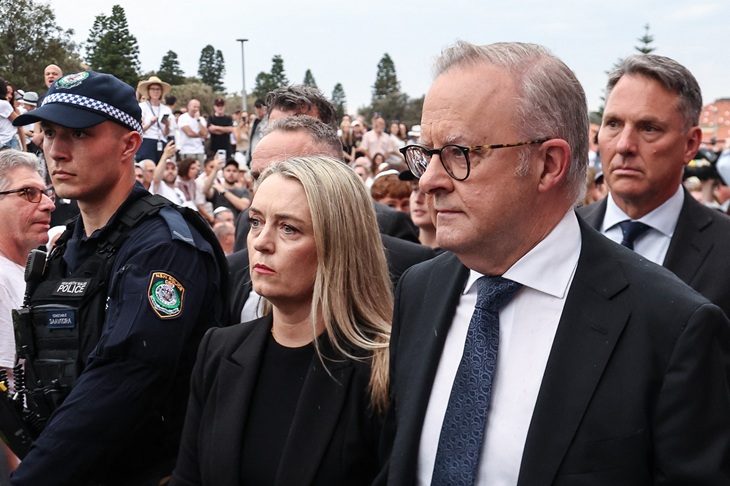
Australia's Prime Minister Anthony Albanese arrives with his wife Jodie Haydon to attend the memorial held for the victims of a shooting at Bondi Beach in Sydney on December 21, 2025. A father and his son are accused of spraying bullets into the family-thronged Hanukkah celebration at Sydney's most famous beach on December 14, allegedly inspired by "Islamic State ideology". (Photo by DAVID GRAY / AFP via Getty Images)
UPDATE: Prime Minister Anthony Albanese is facing mounting backlash as his government pushes through a controversial civil rights bill aimed at combating misinformation and hate speech. This rapid legislative move, characterized by critics as a “two-tier” justice system, threatens democratic norms in Australia and has ignited fierce debate across the nation.
The omnibus legislation, designed to regulate online content and public discourse, has been fast-tracked with little parliamentary scrutiny, raising alarms about its implications for freedom of speech and assembly. Critics argue that this alarming trend erodes the foundations of Australian democracy, which has historically championed individual liberties and open debate.
Just last week, Albanese defended his administration’s rush, claiming it is necessary to protect vulnerable communities, particularly in light of rising antisemitism amid the ongoing Israel-Hamas war. However, Jewish organizations, including the Executive Council of Australian Jewry, have expressed serious concerns that the legislation could suppress legitimate discourse, including pro-Israel advocacy.
“Rushing through measures meant to safeguard a community while sidelining their perspectives is nothing short of cynical opportunism,” said a spokesperson for the Council. This sentiment is echoed by various community leaders who feel their voices are being ignored in a process that ostensibly aims to protect them.
The urgency of this situation is heightened by the recent Bondi massacre, where the government is accused of leveraging public fear to justify sweeping reforms. Critics warn that such a move risks converting Australia from a beacon of liberal democracy into a cautionary tale of executive overreach.
Albanese’s government has been accused of hypocrisy, as the Prime Minister has long criticized other nations for bypassing democratic processes. His previously vocal stance against authoritarianism stands in stark contrast to his current push for expedited legislation without proper public consultation.
This double standard has sparked outrage among citizens who expect their leaders to uphold the rule of law without favoritism. By sidestepping important debate and consultation, Labor risks alienating mainstream society, raising concerns about a two-tier justice system that prioritizes political expediency over democratic integrity.
Political scholars and legal experts are urging the Albanese administration to withdraw the bill and engage in genuine parliamentary inquiry. They stress that Australia’s democratic legacy relies on robust debate and public engagement, not rapid legislative maneuvers.
As this situation develops, Australians are encouraged to stay informed and voice their opinions. The ramifications of this bill could define Albanese’s tenure and reshape the nation’s commitment to democratic principles.
With the stakes higher than ever, citizens are left questioning whether their leaders will prioritize the values of transparency and accountability they profess to uphold. The push for this legislation is not just a political maneuver; it represents a critical moment for Australia’s future as a free society.
In the face of such urgent developments, the demand for public discourse is clear: the Australian public must not only be heard but must also engage in the democratic process that has defined the nation for over a century. The coming days will reveal whether the government will listen or continue down a path that threatens the very essence of Australian democracy.